A responsibility assignment matrix, also known as RACI matrix, is a simple and effective way for defining roles and responsibilities. It's commonly a chart or visual representation of how various entities can expect to work together when completing tasks.
The definitions of each letter in the RACI matrix are as-follows:
R (Responsible) - Does the work or activity to achieve the task. There is at least one role with a participation type of responsible, although others can be delegated to assist in the work required.
A (Accountable) - Ultimately answerable for the correct and thorough completion of the deliverable or task, and the one who delegates the work to those responsible. An accountable must sign off (approve) work. There is only one accountable for each task or deliverable.
C (Consulted) - Provides opinions and advice on the work, such as a subject matter expert. Usually, this involves two-way communication.
I (Informed) - Kept up-to-date on progress or completion of the task or deliverable. Usually, this involves just one-way communication.
Project RACI vs Program RACI
A Project RACI should build off of your Stakeholder Map and have individual employee names, titles, and location within the organization
A Program RACI is one level higher - it denotes how Departments or Lines of Business (as a whole) should work with the Center of Excellence (as a whole)
Note
As a Program RACI is not at the Stakeholder level, a Program Level RACI alone will not result in individual employees knowing their roles and responsibilities. A Digital Adoption CoE should use the Program RACI to discuss the operating model at a high level and a Project RACI should be used more tactically to drive task execution and collaboration.
Handling Changes to Your Governance Model
Your CoE's governance model will evolve over time. As your CoE governance model evolves, the Program Manager should be responsible for updating the CoE Program RACI accordingly.
Get Started
Step 1: Standardize & Plot Phases
Before you start assigning the letters R, A, C, I, take these steps:
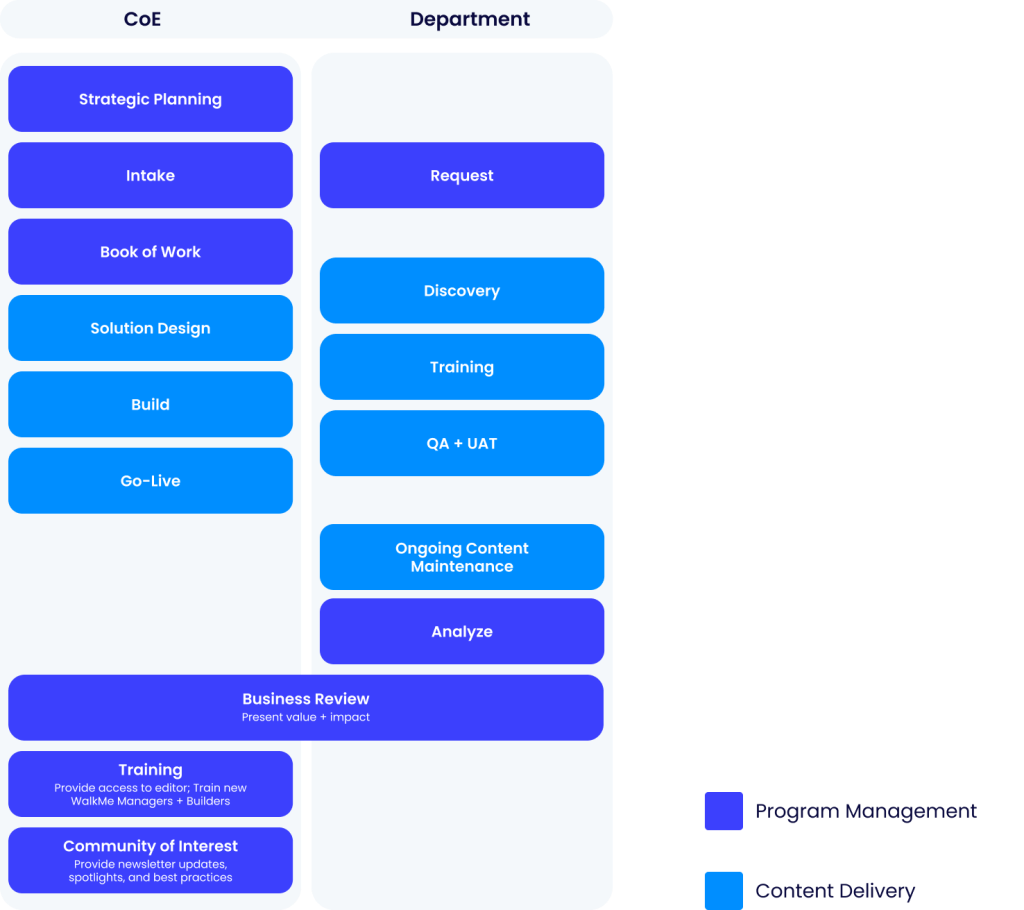
Create a simple T chart (see example below) and write “CoE” on one side and “Department” on the other
Plot the phases on the graph
Tip
If it's difficult to plot a phase, it's telling you something. Any areas of confusion in ownership are at risk of lowered operational efficiency. The Program Manager should flag “confusing” phases as candidates for additional discussion and documented process.
Assign only one Accountable per task (both the CoE and the Department should not be Accountable)
Ensure Accountable has the proper authority to deem the task “done”
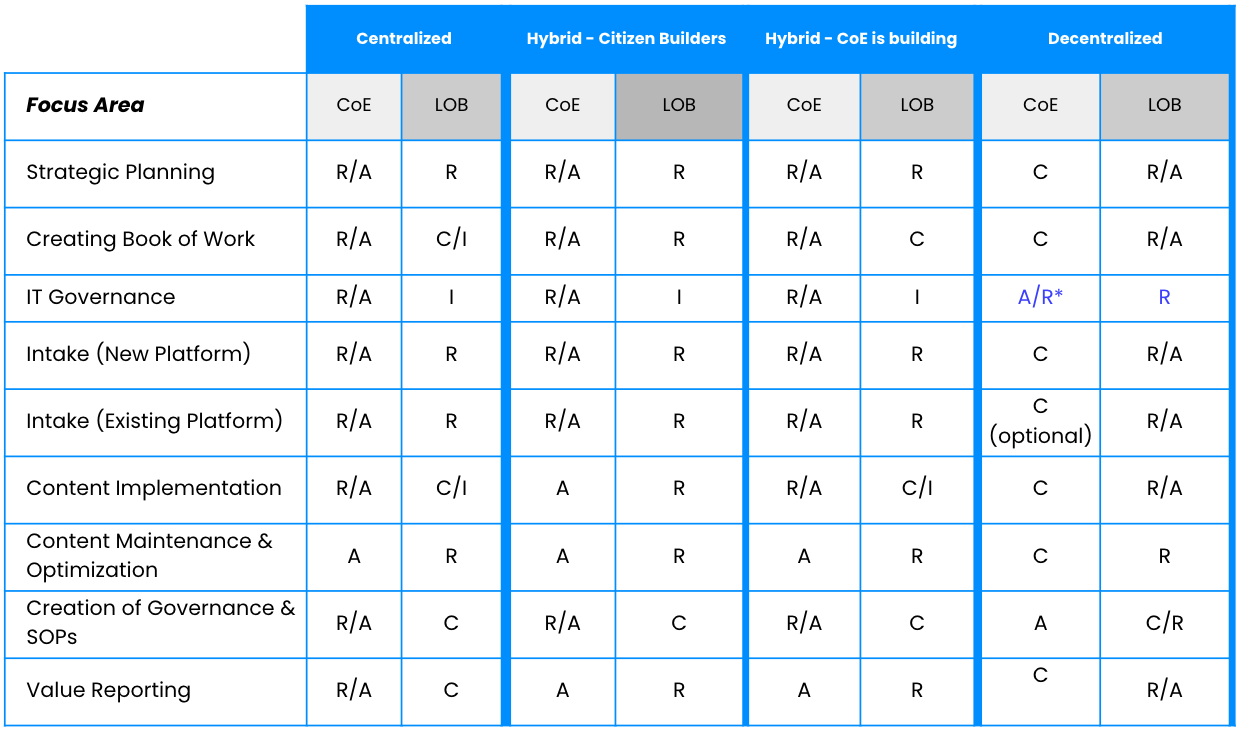
Example High-Level RACI by CoE Program Governance Model
Note
*Try to keep the extension deployment as centralized as possible - if IT is severely siloed, create a Steering Committee
The example RACI above includes two permutations of a “Hybrid” CoE governance model, one where there are “Citizen Builders” (Departments are responsible for building) and one where the CoE provides Builder resources for the Departments