Brief Overview
Enhance your user interactions with WalkMe's AI Conditions, seamlessly integrated into the Condition Builder. The AI text evaluation rule lets you use text analysis to create flexible and responsive conditions without needing exact wording. AI Conditions make it easy to set up dynamic responses that adapt to your users' input, ensuring a more intuitive and effective user experience.
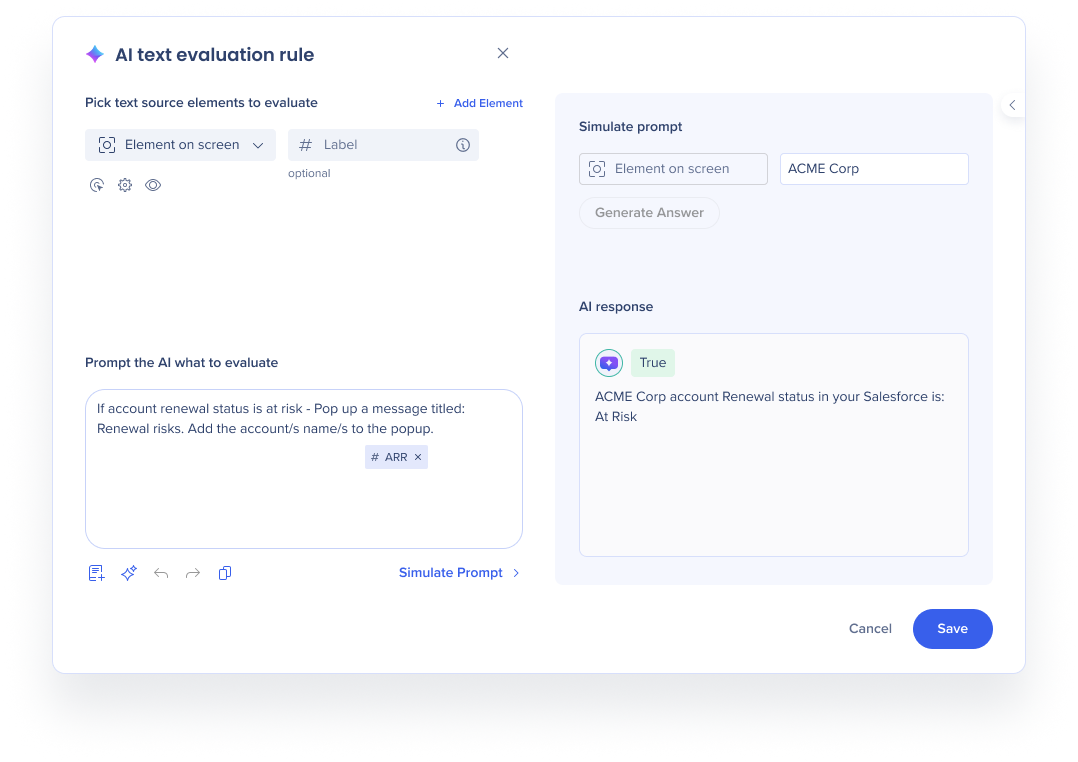
AI text evaluation has its own window for building and testing prompts. You can evaluate more than one text source in a single rule and simulate the result before you save.
Use Cases
Security incident detection in IT ticket descriptions
On the ticket description field, use AI text evaluation → "sounds like a security or data breach incident." If matched, surface a Launcher that redirects the user to the dedicated security incident form, bypassing the standard ticket queue. This is more reliable than keyword matching, since users describe incidents in widely different ways.
Competitor mention in a CRM note
When a sales rep logs an activity note in your CRM, use AI text evaluation → "mentions a competitor" to trigger a SmartTip offering a link to the competitive battlecard for that deal — right in context, without the rep having to search for it.
Legal or compliance topic in a customer service tool
In a customer-facing messaging or case management tool, use AI text evaluation → "relates to a legal, privacy, or liability matter" to show agents a reminder to follow the escalation protocol before responding. More accurate than keyword lists, since customers phrase these concerns in many different ways.
Frustrated or urgent tone in a help desk ticket
When a user fills out an IT or HR help desk ticket, use AI text evaluation → "the tone sounds frustrated or urgent" to surface a Launcher or SmartTip reassuring them of expected response times.
Cross-referencing account data in a CRM
On an account record, add the renewal status and ARR fields as two labeled text sources, then use AI text evaluation → "#renewal_status is at risk and #ARR is above $500K" to surface a SmartTip pointing the account manager to the renewal playbook.
How It Works
AI text evaluation
AI Conditions are powered by the AI text evaluation rule in the Condition Builder. Instead of matching exact phrasing, you describe what the text should represent. The AI evaluates the text against your prompt and returns a True or False result.
For example, you could select a Salesforce account record as the text source and enter the prompt "the account is at churn risk." WalkMe reads the text from the page, sends it to WalkMe's AI engine along with the prompt, and triggers the appropriate response if the condition is met.
- A dedicated window: Build prompts in a full-size field instead of a small text input
- Multiple text sources: Evaluate and cross-reference more than one source in a single rule
- More source types: Use WalkMe data and variables as text sources, alongside elements on the page
- Simulation: Test the prompt with sample text before you save
To open it:
- In the Condition Builder, open Select method
- Choose AI text evaluation
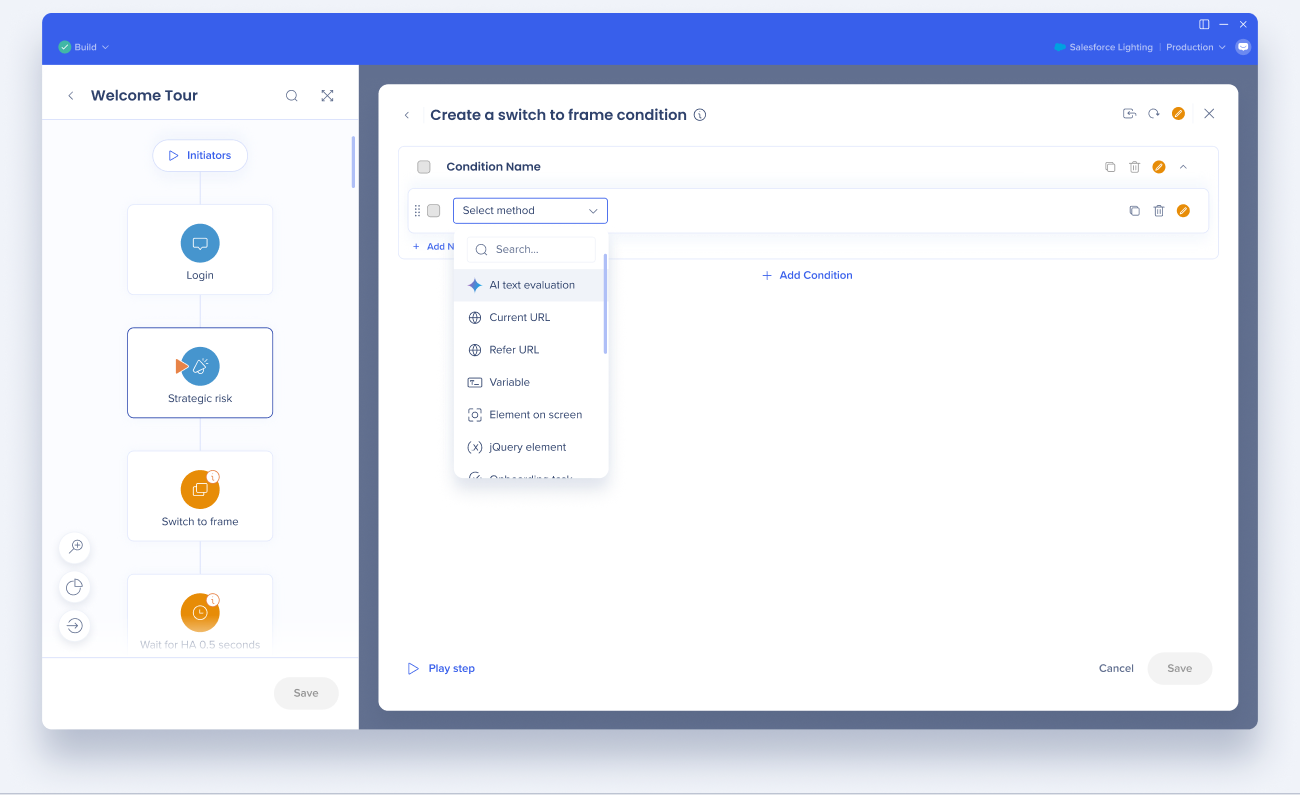
Pick text sources
In the AI text evaluation rule window, under Pick text source elements to evaluate, choose a text source. Selected Element is the default.
Add a label for the source. Labels are required, even when you use a single source.
Available text sources:
- Element on screen
- jQuery element
- Selected element
- Highlighted text
- Focused input
- WalkMe data
- Variable
- Cookie
- URL
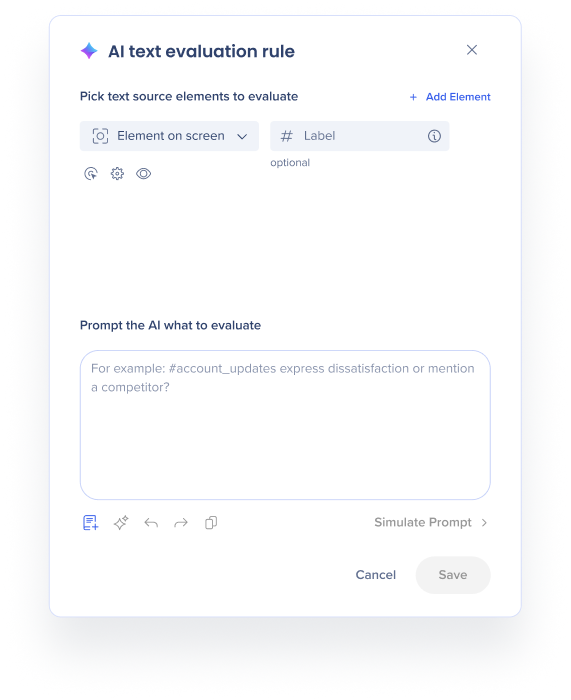
Evaluate multiple text sources
To evaluate more than one source, select Add Element. For example, add a Salesforce renewal status field and an ARR field to check both in one rule.
Each source needs its own label. If one is missing, Add a label to use in the prompt appears when you try to save.
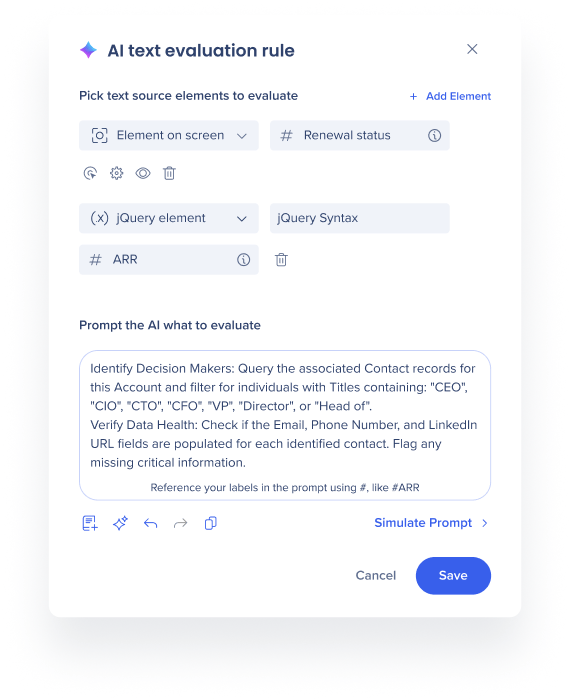
Write the prompt
Under Prompt the AI what to evaluate, describe what the AI should check. To reference a source, type # and choose its label from the list, like #ARR.
The toolbar under the prompt field lets you:
- Add knowledge source: Reference an AI knowledge source in the prompt
- Improve prompt: Let AI rewrite your prompt
- Undo and redo
- Copy prompt
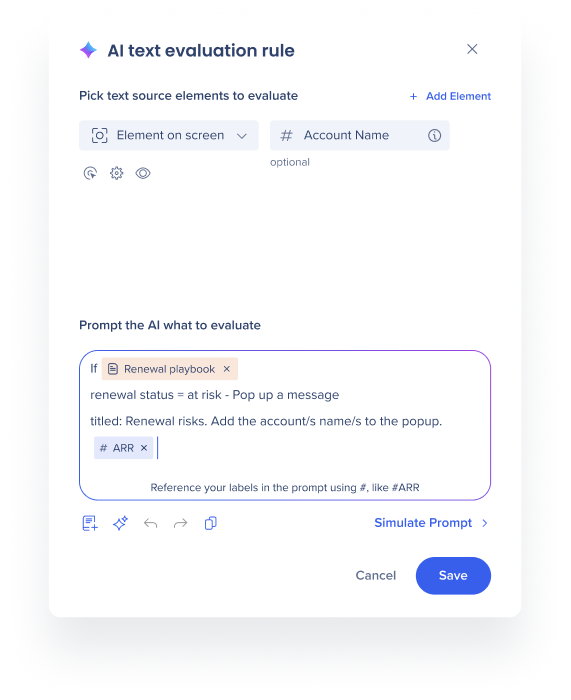
Simulate and save
- Select Simulate Prompt
- Enter sample text for each source and select Generate Answer. The True or False result appears under AI response.
- If the result isn't what you expected, update the prompt and simulate again
- Select Save
Where you can use AI Conditions
You can use AI Conditions anywhere the Condition Builder is available, including:
- Launchers: Display conditions
- SmartTip sets: Display conditions
- ShoutOuts: Auto play conditions
- Onboarding tasks: Display conditions
- Shuttles: Display conditions
- Articles: Display conditions, goals
- Videos: Display conditions, goals
- Surveys: Auto play conditions
- Segments: Segmentation rules
- Smart Walk-Thrus: Auto play rules, goals, split conditions
Technical Notes
Best practices
- Response time: Most AI conditions are evaluated in under 2 seconds, but some can take longer. This depends on the AI service rather than on the prompt.
- If there's no answer in time: The condition is treated as false, so the user's experience isn't blocked.
- Where AI conditions work best: Places where the condition is re-checked continuously, so a late answer still takes effect:
- Launchers
- Auto-play, with Continuous evaluation on
- Wait for step
- Goals
- Where to be careful: Places where the condition is evaluated only once. If the answer doesn't come back quickly, the result is false:
- Segments on page load
- Split steps
- Auto-play, with Continuous evaluation off
- Writing prompts:
- Phrase the prompt as a clear yes/no condition, for example “the account is at churn risk”
- Keep prompts short and simple. Prompts that need complex logic or calculations can slow down the condition
- Use Selected Element where possible. Heavy or complex jQuery selectors take longer to run and can cause delays
- Test every prompt with Simulate Prompt before you save and publish, to confirm it returns the result you expect