Welcome to the
WalkMe Help Center
Please log in to continue
Analyze user journeys. Find friction. Build guidance. Prove impact.
WalkMe Insights helps you understand how users interact with your application and how your WalkMe content is performing. It's your analytics layer for digital adoption that helps you:
Additional resources to learn more about Insights:
About WalkMe Insights
Insights Terminology
Set up your system so Insights can track accurate, user-level data from day one. This foundation determines the quality of every report, funnel, or dashboard you'll build later. UUID is set up by users with Admin permissions when they configure their system before WalkMe content is published.
The UUID (Unique User Identifier) tells WalkMe who is doing what—it's the foundation of all user-level analytics in WalkMe Insights, ensuring every click, play, and goal completion is tied back to a real user. Without a UUID, WalkMe assigns a new ID each time a user enters the system, creating duplicates in Insights and breaking Onboarding and Goal continuity.
For example:
It's a recommended best practice to choose one consistent UUID method across all your environments. While several options are available, we recommend using an IDP integration for internal applications and a variable for customer-facing applications for the most accurate, persistent user tracking. If your organization requires an additional layer of security, you can request to have your UUID hashed.
NOTE: UUID is configured in Data Settings within the Admin Center of the WalkMe Console by someone who has Admin permissions for your account. UUID settings are configured per system, not per account. Some organizations require IT approval to set up an IDP Integration. Reach out to your IT department to identify the person responsible for Identity Access Management (IAM) to request assistance with configuration if needed.
Here are a few additional resources to help you set up your UUID: Unique user settings, IDP, Variables, UUID hashing, Roles & permissions.
WalkMe collects data at three different levels, each offering a deeper view into how users interact with your application and your WalkMe guidance. Together, these levels help you move from simply counting interactions to truly understanding user behavior, identifying friction, and measuring impact. DXA (Digital Experience Analytics) determines how much user-behavior data WalkMe collects beyond WalkMe engagement analytics.
Different DXA levels offer different levels of visibility into how users interact with your website or application. As a best practice, we recommend enabling Targeted DXA so you can define and analyze Tracked Events. Full DXA is only required if you need access to retroactive interaction data, and it's important to note that historical data is only available from the moment DXA is activated.
Session Playback is not required for most Insights use cases and should be enabled only when visual session replays are needed. Session Playback is an opt-in capability only available to customers who have purchased the WalkMe for Customers package.
How to enable: An Admin can select: Admin Center → Data Settings → Data Collection Level → Digital Experience Analytics → Save, Targeted DXA
For example, if Full DXA has been running for 6 months, you can access 6 months of retroactive click and input data. Once Full DXA has been active for a full year, you'll have access to up to one year of historical interaction data.
Important note: Full DXA provides extensive raw data, which can be complex and resource-intensive to analyze. Most customers do not need this level of detail; we recommend Full DXA only for customers with advanced analytics needs and the capacity to handle large datasets.
How to enable:
If you have a CSM: Contact your CSM with the names of the systems that require Full DXA.
If you do NOT have a CSM: Email success@walkme.com with your request.
Important: DXA is enabled per system, not per account. If you have multiple systems, Full DXA must be enabled for each one individually.
NOTE: Session Playback does not currently support mobile devices and only operates on certain browsers. Learn more.
How to enable:
1. Verify eligibility
Check with your Account Team to confirm whether your contract includes WalkMe for Customers.
2. If eligible:
If you have a CSM: Ask your CSM to enable DXA + Session Playback.
If you do NOT have a CSM: Email success@walkme.com to request activation.
DXA includes governance controls that allow administrators to define what interaction data may be collected. If needed, use Censorship and Privacy settings to restrict the collection of specific elements on your site to align with your organization's security and compliance requirements.
Here are a few additional resources to help you set up your data collection level: Digital Experience Analytics (DXA), WalkMe Events Settings, Session Playback.
To understand how users interact with your application, use Engaged Elements or Tracked Events to collect baseline data before publishing WalkMe content. Without a baseline, it becomes difficult to demonstrate how your WalkMe solutions improve user behavior.
We recommend collecting baseline data for at least 30 days before publishing WalkMe content. This ensures you can confidently measure before-and-after impact. We highly recommended making this a standard practice before deploying new WalkMe content.
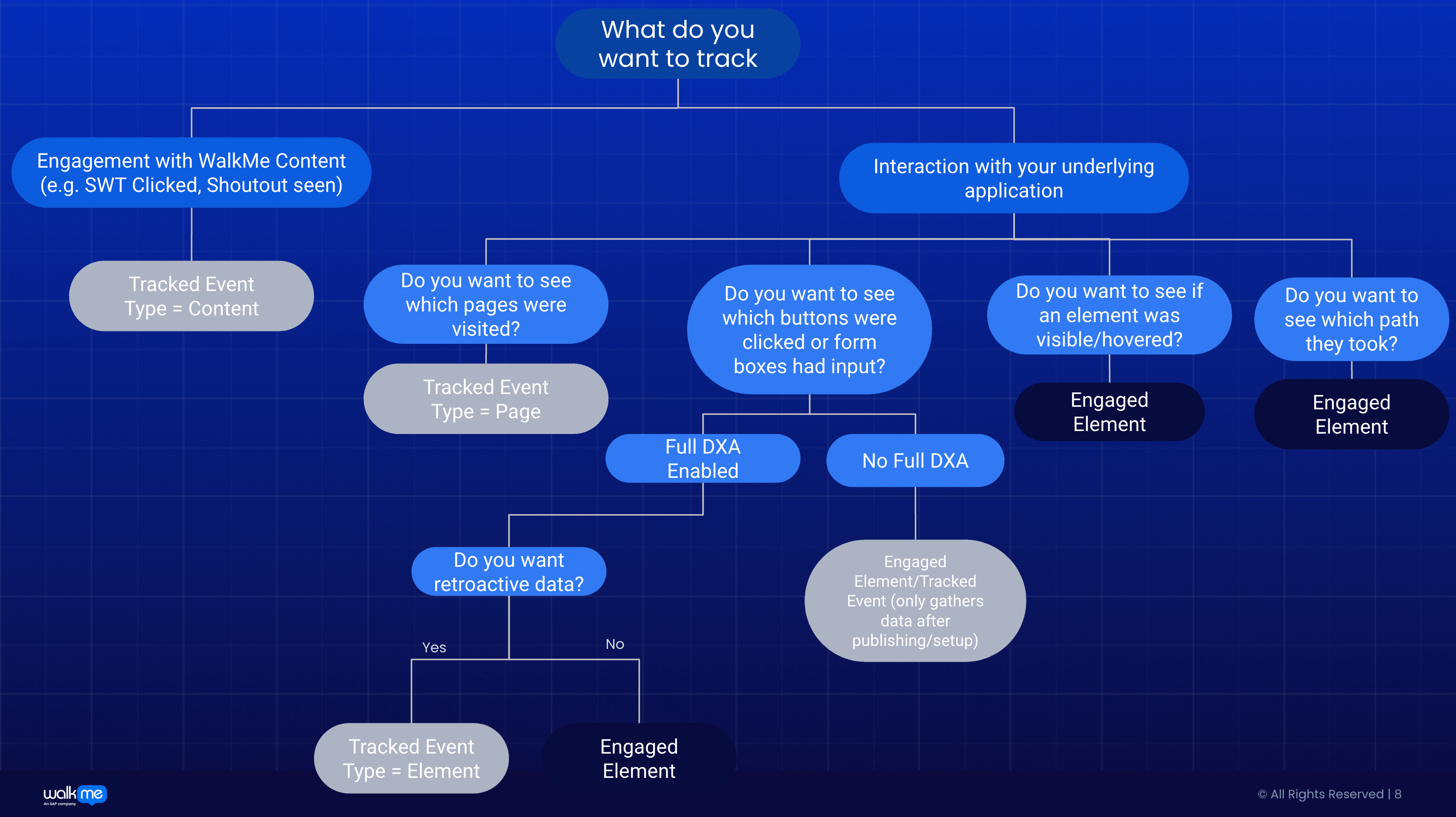
Events are the building blocks of Insights analytics. They help you understand how users interact with your application - which buttons they click, which pages they visit, etc. There are two ways to set up events: Engaged Elements and Tracked Events. It's important to know what each method captures since they form the foundation of all Insights analytics.
Requires DeepUI to be enabled.
Additional resources to help you set up Events: Collect Baseline Data with Engaged Elements or Tracked Events, How to create Events, About Insights Engaged Elements.
Address the friction points you've discovered by deploying WalkMe content, then prove it made an impact. Deploy WalkMe guidance where friction exists.
Add Goals in each Smart Walk-Thru, ShoutOut, Resource, or Shuttle — and a completion goal for each Onboarding Task. Goals connect usage to outcomes so you can see if users who engaged with the guidance actually achieved the outcome it was designed to achieve (e.g., “Clicked Save” or “Form Submitted”).
Publish to production and let users interact for at least a week.
To measure whether your WalkMe guidance is gaining traction, you need to look at how users are viewing, playing, clicking, and interacting with each content type across your system. WalkMe Engagement Analytics provides metrics that tell you how often WalkMe content is being surfaced and used. These metrics appear across most app dashboards in Insights, particularly in Smart Walk-Thrus, SmartTips, Launchers, ShoutOuts, Resources, Shuttles, and Surveys.
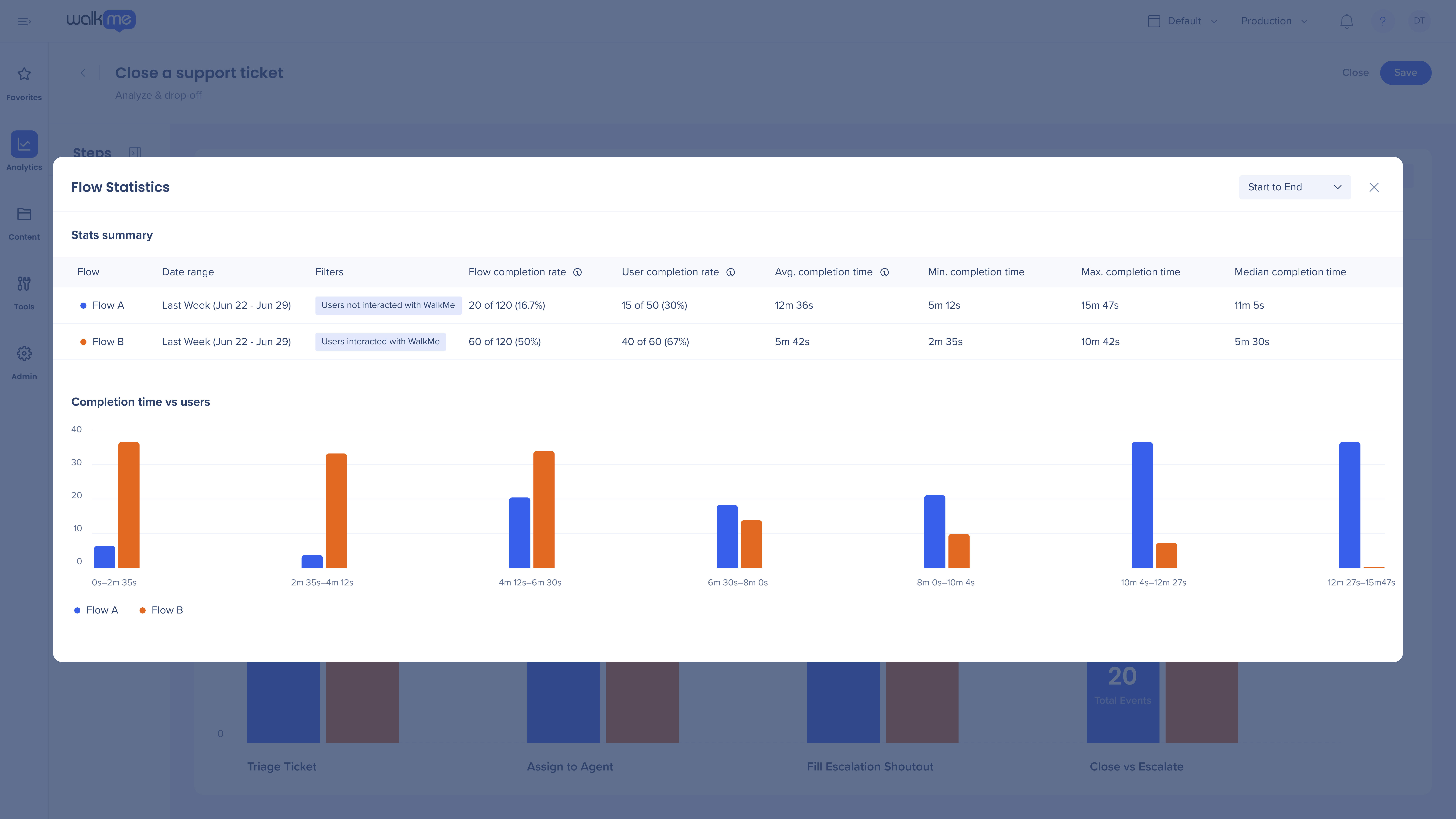
Use Compare Mode to visualize side-by-side how performance changes before vs. after WalkMe, or compare the same flow with different date ranges and filters. Measuring before vs. after WalkMe helps you clearly demonstrate WalkMe's impact on process success.
NOTE: The combination of using Flow Analytics and Goals help show how WalkMe made a measurable difference. Remember to effectively measure before-and-after impact using Compare Mode, baseline Events need to be set up before WalkMe guidance is deployed.
Flow Analytics helps you visualize sequential user behavior — showing how users move through multi-step processes, where they drop off, and the alternate paths they take when navigating a workflow. Unlike traditional analytics that track isolated events, Flow Analytics connects the dots, revealing the actual sequence of steps users take across pages, systems, and WalkMe content.
Flow Analytics works best for structured business processes with a clear start, middle, and end, where the order of steps matters. It's ideal for processes like onboarding, sales qualification, form submission, financial approvals, and other multi-page workflows. Flow Analytics is not designed for unstructured exploration or single-click analysis. Use it when you already know the sequential process you want to analyze and optimize.
Flow Analytics answers the critical question: Are users successfully completing the workflows that matter to our business? It's a powerful tool for understanding where processes break down and your proof point for demonstrating the measurable impact of your improvements.
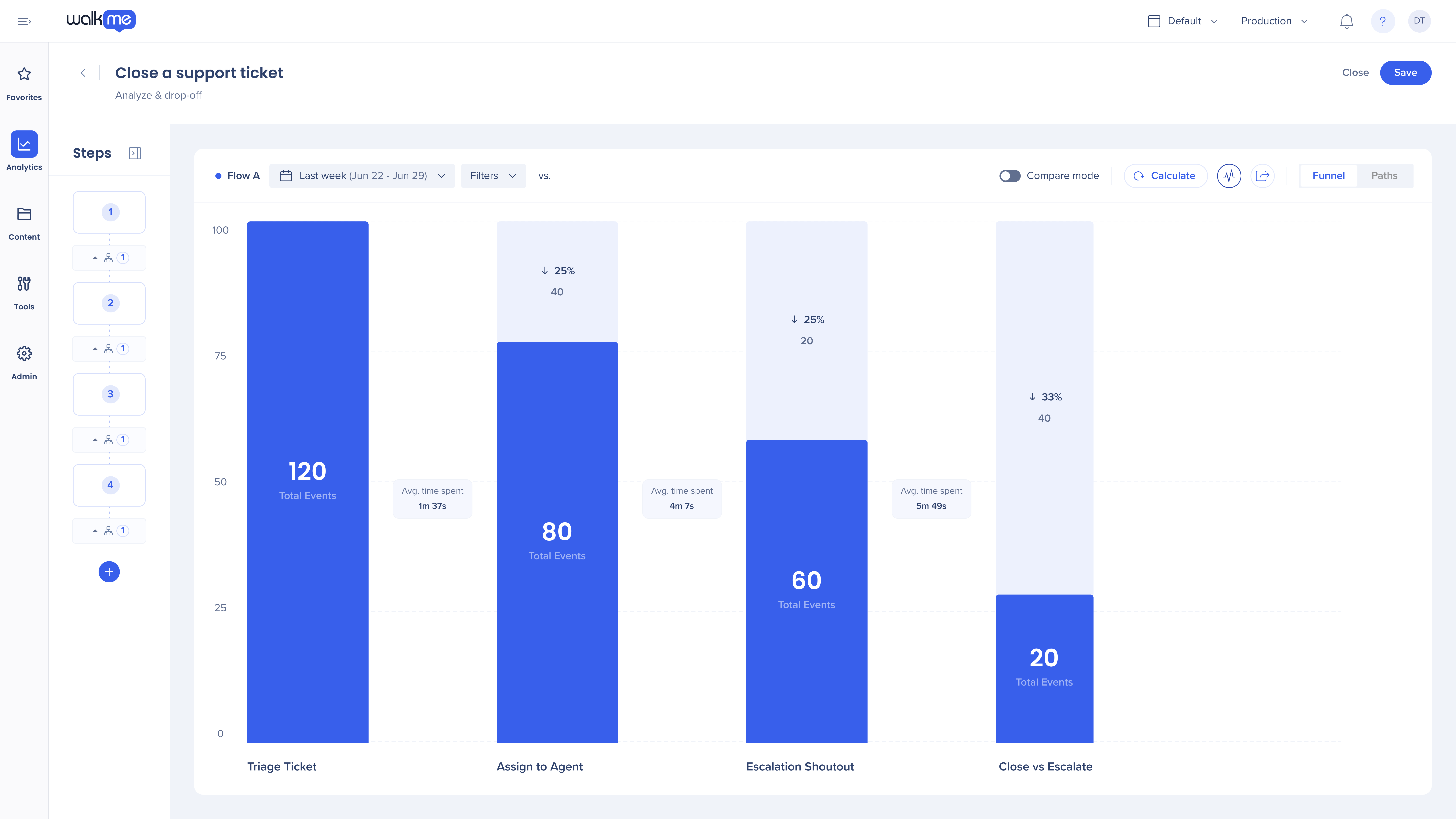
Funnels tell you how many users progress from Step 1 → Step 2 → Step 3, etc. in the exact order you defined. You can see where users drop off and how long each step takes. They're ideal for tracking completion rates, diagnosing drop-off, understanding time-to-completion, and measuring before/after changes when improving a process or adding WalkMe guidance.
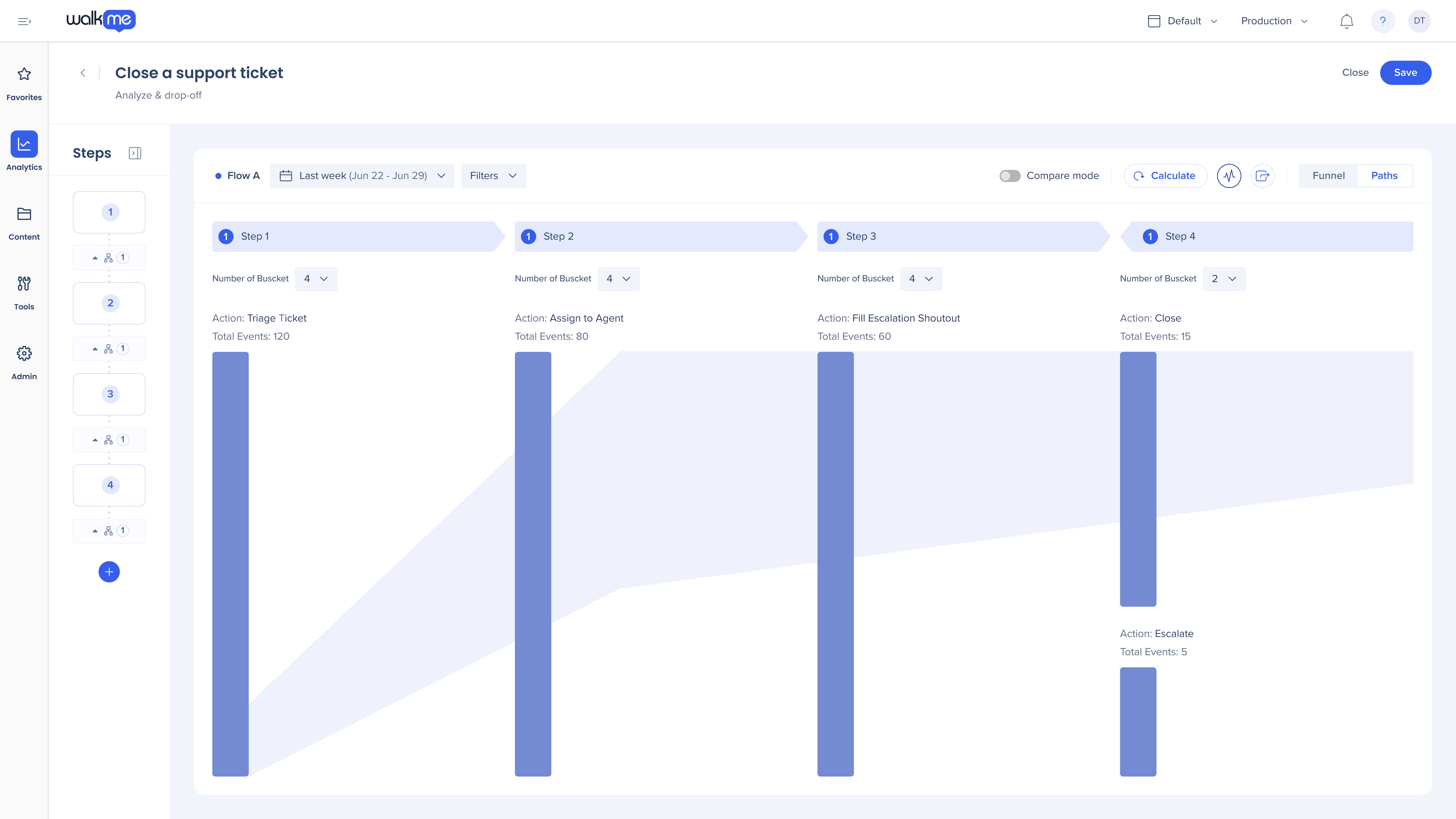
Paths reveal how users actually navigate the workflow. They surface unexpected behaviors, alternate routes, loops, and confusion points, often highlighting steps you didn't know needed guidance. Paths reveal how user behavior differs from your intended sequence.
Show Data As / Split By break results down by user attributes (e.g., location, browser, segment) for more detailed user analysis. Show Data As enables you to select a particular property and analyze your data based on that property. This means you can analyze your data not just by events, but also by other factors such as “Number of Users,” "Country" or "Browser". This can be particularly helpful when trying to identify specific issues within an event, rather than analyzing the event as a whole. Split By enables you to segment data based on a property in the Paths view. This allows you to analyze data for each step based on additional factors such as "Country" or "Browser", and view the results under that step.
Comparison Mode in Flow Analytics allows you to compare the same flow side-by-side so you can measure how behavior changes across time, segments, environments, or audiences. This is one of the most powerful features in Flow Analytics because it turns your funnels into a before-and-after story, helping you clearly demonstrate where improvements worked—and where friction still remains. It transforms Flow Analytics from a diagnostic tool into an impact measurement tool, making it easier to justify decisions, communicate value to stakeholders, and guide your next round of optimizations.
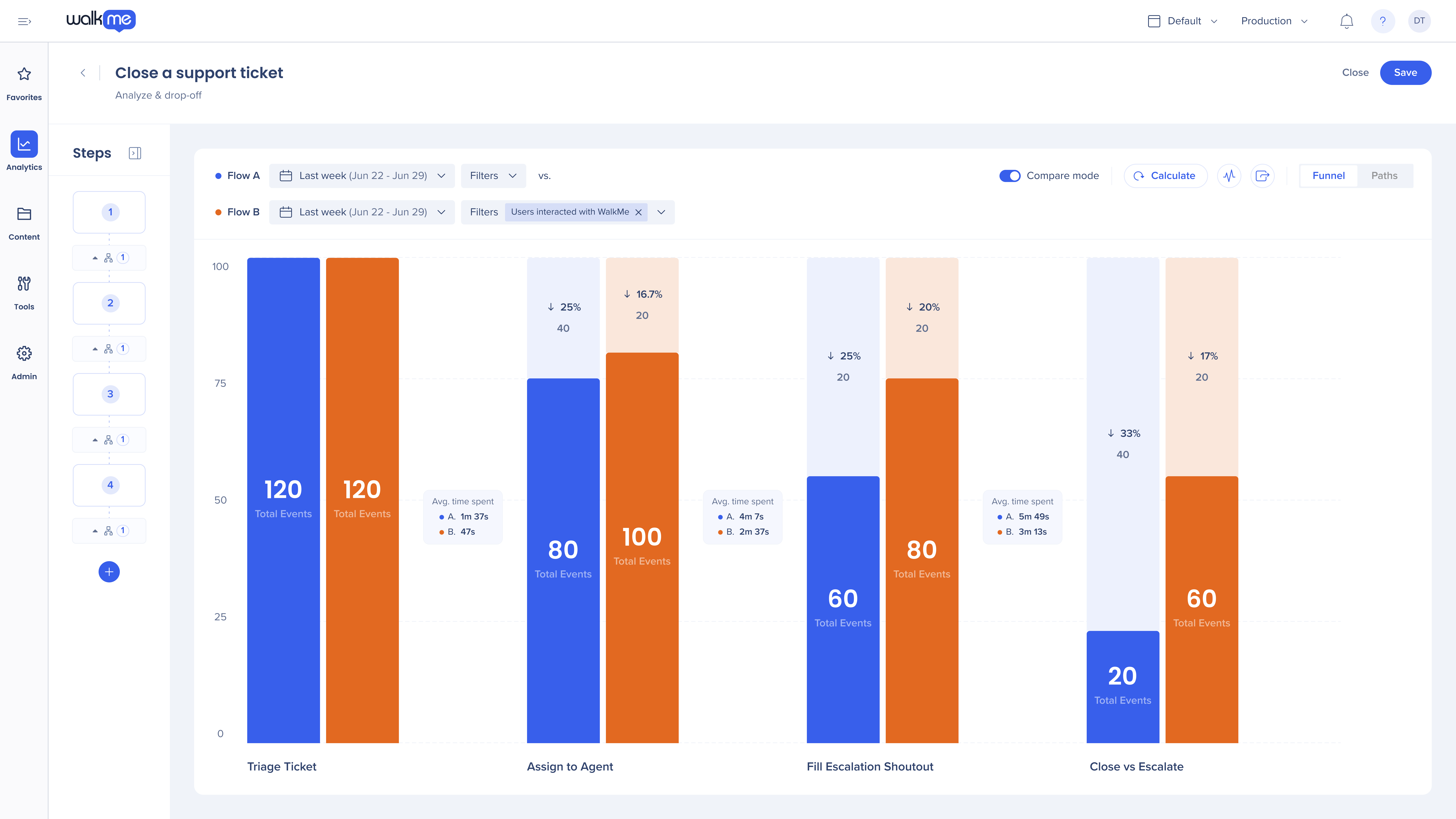
NOTE: Use Funnels to track user conversion between steps and the time users take to complete each step. Use Paths when you want to understand which routes users take in the intended workflow. Flows focus on the sequence of user actions rather than isolated events. Each step in a flow must be completed in order for the user to progress to the next step. If a user does not complete a step, they will not be recorded for subsequent steps, and no data will be shown for that user beyond the incomplete step.
Additional resources to help you set up Flow Analytics: Flow Analytics, Tip Tuesday: Utilizing Flow Analytics.
Understanding whether your WalkMe content is effective goes beyond counting plays or clicks. Content effectiveness tells you how well your guidance is helping users complete tasks, make decisions, or correct mistakes.
You can also set up a custom dashboard, subscribe to reports, and create data integrations to measure the impact of your WalkMe content alongside your own business data. The Reports Gallery is your central hub for exporting, reviewing, and subscribing to analytics reports in the WalkMe Console. This is where you go when you need raw data, scheduled reporting, or cross-system insights that help you validate performance, share data with stakeholders, or support more advanced analysis outside of WalkMe. There are a lot of out-of-the-box Insights reports, but you can also create custom reports. The most popular report templates that customers use are: End Users and WM Engagement, Tracked Events Analysis, Walk-Thru Analysis, and Survey Analysis.
WalkMe's Custom Dashboards allow you to create personalized visualization views of your data—giving you the flexibility to monitor KPIs, track user behavior, and visualize adoption trends in a format that speaks directly to your program's goals. Custom Dashboards enable you to build tailored collections of widgets that highlight the metrics you care about most, all in one place.
Additional best practices resources for building content and creating reports: Best practices for building WalkMe solutions, Human-centric design tips, About Insights reports, Insights pre-build reports.
Summarize your Insights findings and confirm WalkMe's impact on downstream business outcomes with stakeholders. For example, after deploying WalkMe content, did you see a decrease in support tickets or increased adoption of a key feature?
Document your success stories and schedule a stakeholder readout to share measurable results. Keep in mind that every digital experience has room to grow. WalkMe Insights helps you uncover hidden friction, measure what matters, and demonstrate the value of every improvement—turning Insights into a continuous cycle of optimization and digital adoption growth.
Additional resources for how to share your wins with stakeholders: A practical guide to sharing your DAP wins.