Brief Overview
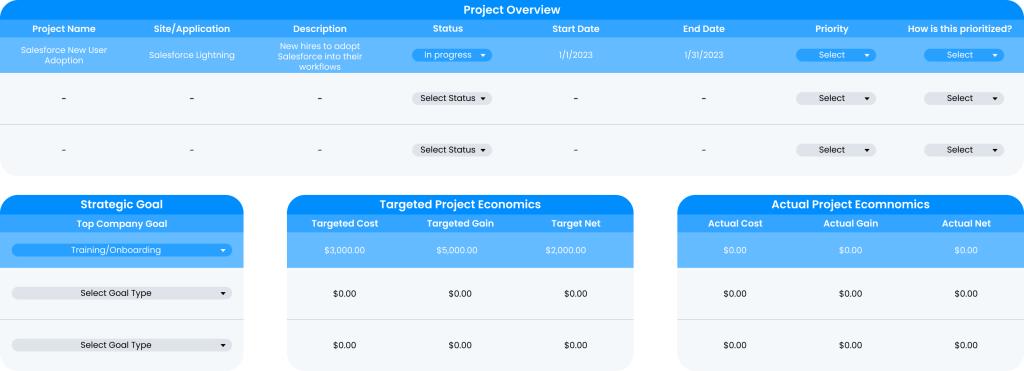
A Book of Work is a consolidated list of current and planned WalkMe projects over a period of time. A structured Book of Work allows project teams to prioritize strategic and ad hoc requests. Typically, this is an output of an Intake Process & Prioritization Framework.
The following are commonly included in a Book of Work:
- Defined set of criteria for projects
- Estimated level of effort for completion
- Actualized and projected benefits to the organization
How This Impacts Your Program
❌ A lack of an agreed-upon Book of Work can lead to one or more of the following:
- Resources allocated to projects with lower ROI
- Increased time to value due to complexity
- Missed opportunities
- Disconnect from purpose of program
Who Is Involved
Your Program Manager should be the primary owner of the Book of Work, with your Executive Sponsor and/or Steering Committee looped in as either a consulted or informed party on final roadmap and prioritization decisions.
Note
The following are important considerations based on the type of governance model your Digital Adoption CoE has in place. See Common CoE Governance models for more information.
- If you have a Centralized governance model, you will only have one Book of Work for your entire Digital Adoption Program. If you move from Centralized into a Hybrid or Decentralized governance model, you will likely have multiple Books of Work.
- If you are sharing resources amongst implementation teams (i.e. you have a Hybrid model with a central team of Builders and they build for multiple departments) ensure the sum of effort estimations does not exceed the total Builder bandwidth.
- If you have a Hybrid model with multiple Books of Work, some arms of your program will inevitably be more self-sufficient. The core governance team should encourage knowledge-sharing and adoption of “best practices” so Book of Work components can be easily summarized for reporting to executives (e.g. total estimated effort for all projects across the COE for this/next quarter, total projected benefits per value driver)
Key Considerations
Though a primary resource for the core Program Manager(s), Project Lead(s), Builder(s), this resource should be organized well enough that the should the Program Manager(s) or Project Lead(s) can easily summarize information for Executive Sponsors.
Tip
For easier adoption, integrate your Book of Work into a platform already used at your organization: Smartsheet, Monday.com, JIRA, spreadsheet in Sharepoint, etc. Ensure licensing is available to all core Program Managers and Project Leads.
Digital Adoption Institute
- Who or what is needed to prioritize between projects? (e.g. cash impact, non-cash impact, effort estimation, ELT priority, corporate objective, etc.)
- How are the projects tied to business objectives? (See Business Value Alignment for more detail on goal cascading from Strategic to Digital Adoption objectives)
- Did we require due diligence from the business stakeholders to come up with actual and projected impact?
Get Started
- Identify strategic projects (“top-down” initiatives) for next 2 quarters and estimate effort to complete
- Plot these projects on a roadmap
- Review resource capacity and subtract strategic project effort, to determine amount of “bottom-up” intake you can handle (i.e. 75% top-down, 25% open to intake requests)
- Determine if this capacity is acceptable or you need to invest in additional resources
- Document the following in a basic Standard Operating Procedure:
- Discovery questions you use to prioritize
- Where the Book of Work lives (what software/how to access)
- Procedure, cadence, owners, and needed documentation to create/update the Book of Work
Take it a step further:
- Consider creating a basic prioritization calculator to assist in the efficient & non-biased prioritization of incoming requests
Additional Resources & Peer Connections