Brief Overview
A Standard Operating Procedure (SOP) is a set of comprehensive instructions compiled for teams to carry out routine processes. SOPs aim to achieve efficiency and consistency, while reducing miscommunication and mistakes.
What Needs a SOP
SOPs are for any repetitive process that could benefit from operational efficiency, especially with multiple, cross-functional parties involved. Clear SOPs are one of the foundations of a successful, scaled digital adoption strategy (and a Digital Adoption Center of Excellence).
What's Included in a SOP
Use the 5 W's (Why, Who, What, When, Where) to understand what should be included in a SOP. Always start with the Why.
Why
- Why does this process need standardization?
- Why does the act of standardizing, positively benefit the organization?
Who
- Who is involved in this process? Who is responsible, accountable, consulted, and informed?
- Who has final authority to say this process has been completed to expectations?
- Who is responsible for updating the SOP if environmental or economic factors change in the organization?
- Who should be contacted if there are questions on the SOP?
What
- What is the process that needs to be followed?
- What are the steps to complete?
- What are the phases of this process?
- What is the “definition of done” at each phase?
When
- What happens before and after this process?
- What are the triggers to start and end this process?
Where
- Where do the required documents live/where does someone access them?
- (+ Does everyone required, have the right permissions to access)?
What an SOP looks like
An SOP often includes one or more of the following components:
Flowchart
Table
Word document to add detail to any visuals
Tip
Don't add so much detail that the SOP becomes unusable. If you find your SOP becoming text-heavy, consider supplementing with a flowchart/visual to simplify.
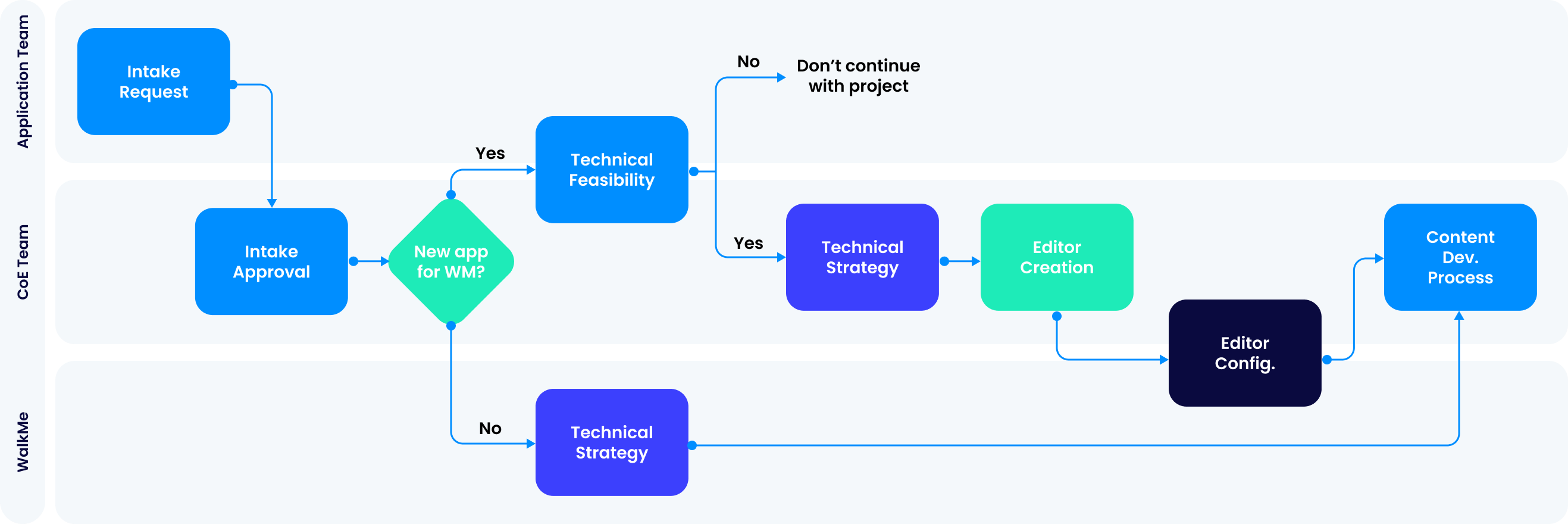
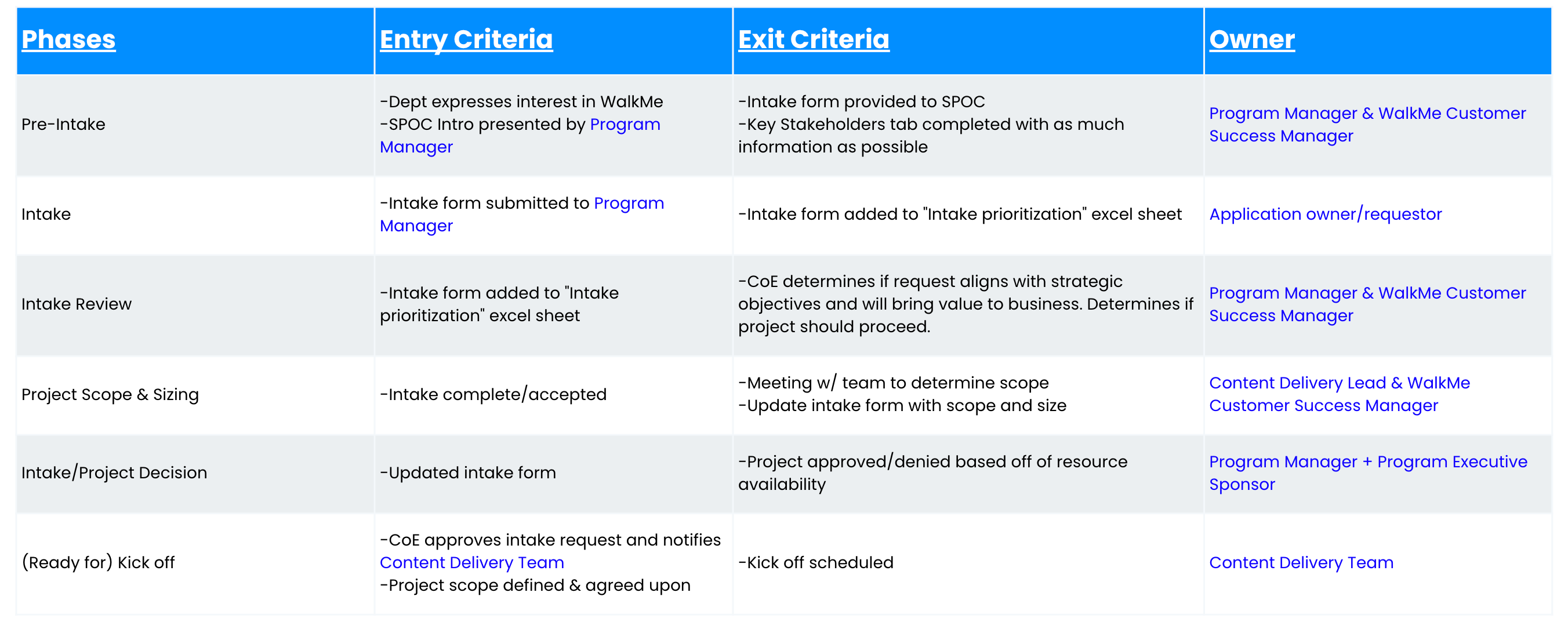
Common DAP SOPs
Start with standardization at the implementation/project level.
Tip
It's important to know the difference between Project Governance and Program Governance.
Both - Aim to create consistency, scalability and efficiency through frameworks and standard operating procedures
Project Governance - Control of content creation and execution of DAP projects.
Program Governance - How DAP functions holistically within the organization.
See Project Governance vs Program Governance for more information on this topic.
Common SOPs for Project Governance include:
Stakeholder Management
Editor Organization & Naming Conventions
User Permissions Management
Content Branding & Style Guidelines
Knowledge Documentation
Project Reporting
Once you've standardized Project Level Governance, move into Program Governance with the following SOPs designed to be the foundation for a Digital Adoption CoE:
Intake (Includes Prioritization & Approval)
Stakeholder Management (Broadened to include processes for the CoE to communicate more widely with current and prospective stakeholders as your DAP reach expands)
Technical Setup
IT Governance
DAP Project Lifecycle
Content Maintenance
Value Reporting (Broadened to include processes for reporting more aggregate value, by value driver, across multiple projects and departments)
Assets vs. SOPs
An SOP is the standard process & ownership. Assets are corresponding tools which make the SOP tactical & actionable.
Consider the following scenarios:
Asset without an SOP
Situation: Our CoE has an intake form but is not consistent with whether we use it.
Potential negative impact: Inconsistency in operations & stakeholder experience
SOP without an Asset
Situation: Our CoE has an intake process written on a slide and in a word document, but we don't really enforce a formal intake form.
Potential negative impact: Wasted administrative work documenting the “ideal process” but not putting it into action; Inconsistency in operations and stakeholder experience
Tip
Don't let your SOPs die in a Knowledge Base! If you are going to create or update an SOP, ensure you have a rollout, education, and governance strategy to ensure your processes are understood, adopted, and enforced.
Get Started
Understand the difference between Project Governance and Program Governance
Start small: You don't have to write a whole SOP all at once. Little bits of standardization go a long way, for example:
Who are your stakeholders? How often do they receive communications? (This is the start to your Stakeholder Management & Communication SOP)
What questions does the CoE ask to vet a potential project? (This is the start to your Intake SOP)
Additional Resources & Peer Connections