Get started: Download templates now
Brief Overview
Whether you are prioritizing within a project (which workflows should we build first?) or between projects (We have lots of requests - which project should we address first?), a prioritization strategy is critical.
In addition, an intake process outlines the needs, outcomes, and relationship between the WalkMe content requester and DAP delivery team. A streamlined intake process is one of the first steps to expanding Digital Adoption's reach at your company and creating a practice of Operational Excellence.
How This Impacts Your Program
Outcomes if done well
- Streamline information gathering
- Clearly set expectations on project approval process and timeline
- Early value alignment between requestor and CoE
- Leading indicator of CoE success
Outcomes if not well
- Inability to scale
- Misaligned expectations of requestees
- Resources tied up in low-impact projects
Step 1: Set Prioritization Criteria
Even if you're not ready for a full intake process, standardizing prioritization questions is a great way to improve efficiency during the discovery phase of a new project.
When prioritizing, consider asking questions addressing the following three (3) categories:
- Impact: What is the expected effect on business objectives and KPIs?
- Complexity: How intricate is/are the workflow(s)? How difficult will the implementation be given other organizational constraints?
- Reach Which departments and how many people will benefit from this?
See Download Templates & Tools below for a sample list of prioritization questions you can work from! Review the list (add, subtract, edit) until it fits your company's needs.
Tip: Start simple
Quick wins create confidence, tangibility, and marketability to propel WalkMe forward at your organization. Make sure your definition of success is clear, measurable, and agreed upon by leadership.
As you mature and WalkMe has your organization's vote of confidence, you can start taking on more complex projects only if the benefit is clear, measurable, and significantly outweighs the input costs.
Remember, more complex projects mean higher resource costs both for the initial build and long-term content maintenance efforts.
Most customers only consider the initial implementation efforts when prioritizing. Make sure you consider the long haul before taking on a project of higher complexity.
An intake form is a document for requesters to fill in and submit for the DAP team's review. See Download Templates & Tools below for intake form templates to start with.
Integrate this process for higher adoption.
Best in class companies embed an intake form in their current workflows and technologies. For example:
- Company A has a shared service request process in ServiceNow. This request process now includes the ability to request support from the Digital Adoption Center of Excellence.
- Company B uses JIRA and has embedded the WalkMe request process in the JIRA ticketing flow.
- Company C hosts all request forms in Sharepoint and now have a customized Digital Adoption Request for Support form.
- Company D uses a WalkMe Launcher called "Feedback on the In-App Experience" that links to a Request Form.
Step 3: Map Your Intake Process
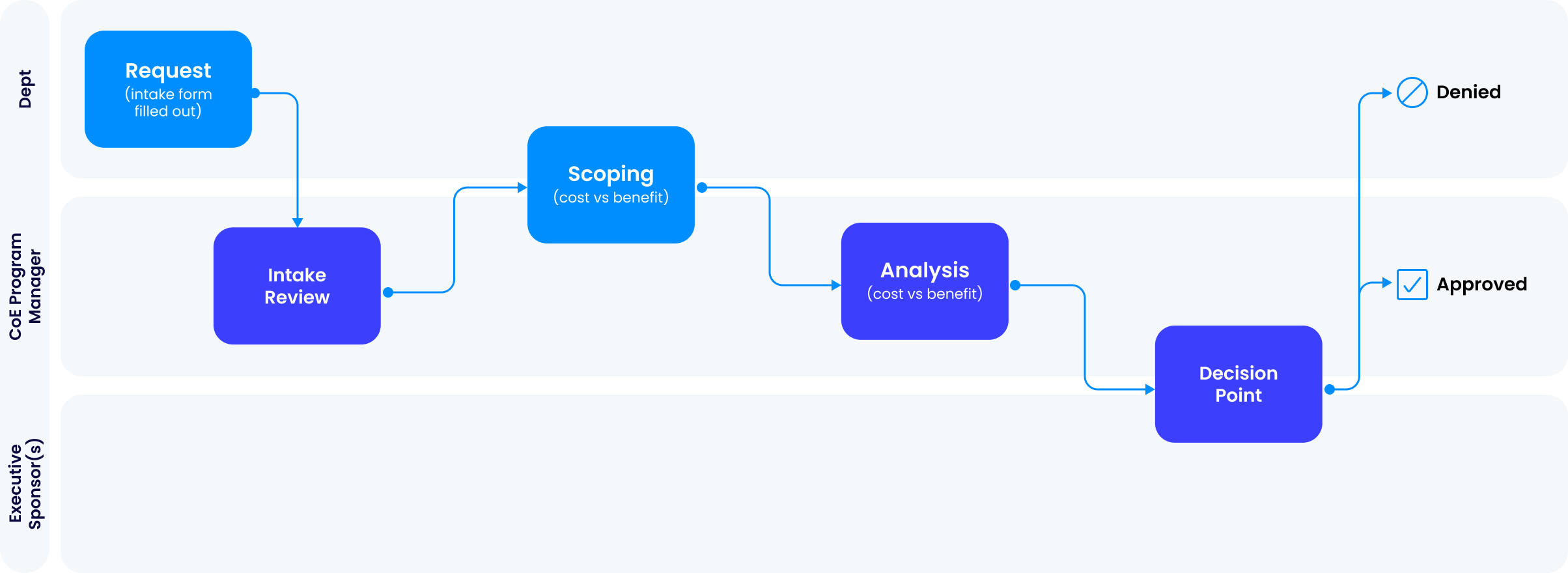
An intake process is the Standard Operating Procedure with steps from Request to Approval/Decision Point. It should include phases with clear definition of ownership and entry/exit criteria. The best standard operating procedures include two components: a visual mapping (for high-level understanding) and a detailed description (often in a table format, with a row for each phase).
See Download Templates & Tools below for an intake process template with both a flowchart and detailed table view.
Step 4: Create Stakeholder Communications
What happens when a request is submitted? As this will be a situation you encounter repeatedly, standardizing a response is critical to optimize your time and set proper expectations with the requestor.
Recommendations for this include:
- Email templates or automated response
- One-pager or handbook with answers to FAQs for partnering with the DAP team (See Download Templates & Tools below for one-pager and handbook templates).
Frequently Asked Questions
Communication material should answer the following:
- How soon should I hear back about my request?
- What is expected of me if this project is accepted? What services are provided by the DAP team and what am I responsible for?
- What is the typical project cycle time?
- Where can I see examples of WalkMe solutions already live at my company?
Tip: Think about the stakeholder journey
Variations of this material may be shared in different stakeholder stages. Consider creating different templates for these different journey points:
- I am a business leader interested in WalkMe and I need to know how to submit a request.
- I submitted a request and need to know what's next.
- My request was approved and I need to know what's next.
Checklist for Success
Checklist for Success
As part of the intake process, the following should be created:
☐ Intake Form
☐ Intake Standard Operating Procedure (SOP)
☐ Email templates or automated response with ticketing/tracking system of choice
For the best outcome, consider these questions:
☐ Where does the Intake form/process live?
☐ Where does someone learn about the Intake form/process?
☐ How does someone submit the Intake form? What is the process from submission to approval?
☐ What is the approval criteria?
☐ If the CoE implementation team doesn't have capacity to take on the project, does your governance model allow the flexibility of assigning Builder ownership to the departments, or is your CoE team fully centralized?
Prioritization Question List
Includes sample questions using the Impact/Complexity/Reach framework to help you prioritize your workflows and/or projects. Review the list (add, subtract, edit) with your team until it fits your company's needs.
Download here.
Intake Form Templates
Includes three (3) intake forms with varying details of KPI and application questions.
Download here.
Intake Process Templates
Includes an example intake flowchart and description of project approval stages. Emphasizes how to use WalkMe's Strategy & Value Framework (the 4 P's) in intake and approval to ensure your book of work is highly aligned to strategic initiatives.
Download here.
Intake & Delivery Handbook for Stakeholders - Template
It's a stakeholder's first time working with the DAP team. Share a handbook to create a working agreement and set expectations up-front. Includes sections for a WalkMe product overview, as well as outlines of roles & bandwidth expectations (both during the project and after go-live), stages in the content delivery process, and communication structure.
Download here.
Intake & Delivery Whitepaper for Stakeholders - Template
It's a stakeholder's first time working with the DAP team. Share a 1-3 page whitepaper to create a working agreement and set expectations up-front. Includes sections for a WalkMe product overview, as well as outlines of roles & bandwidth expectations (both during the project and after go-live), stages in the content delivery process, and communication structure.
Download here.