Brief Overview
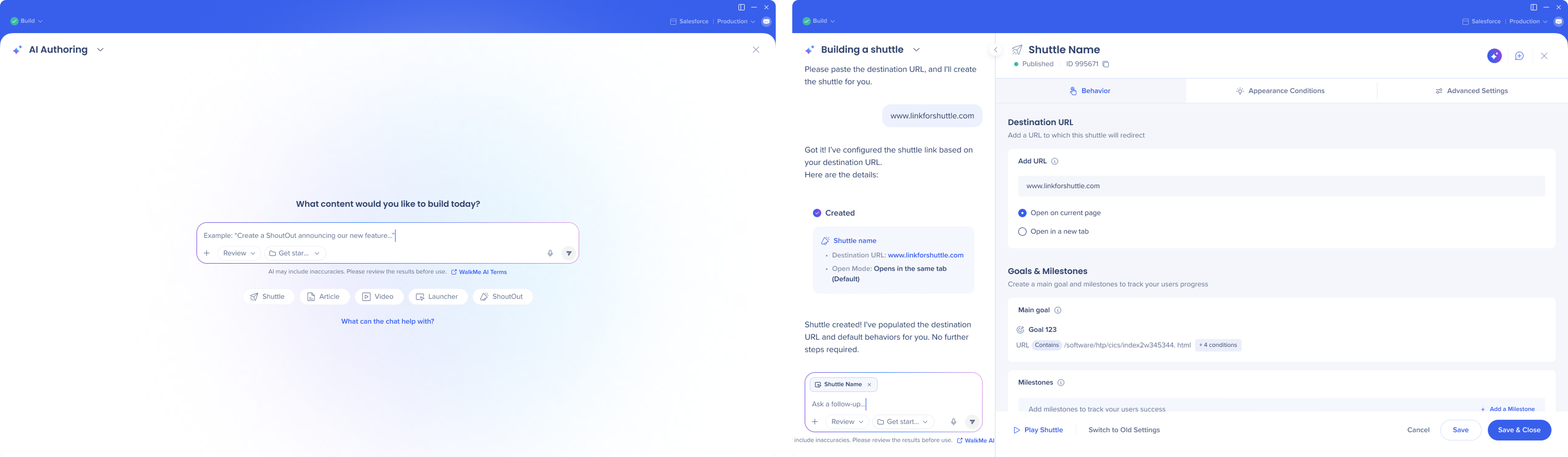
AI Authoring lets you create and modify WalkMe content by describing what you want in plain language, instead of building it manually.
Whether you need to adjust complex CSS rules, construct advanced logic conditions, or collaborate in isolated parallel project sessions, the AI handles the execution so you can focus entirely on the user experience.
Note
AI may include inaccuracies. Please review the results before use.
Use Cases
- Create items such as shuttles, ShoutOuts, launchers, articles, and videos
- Query and modify existing content
- Extend content you've already built
- Construct appearance and behavior conditions in natural language
- Edit CSS in free text
How to Enable
To enable AI Authoring:
-
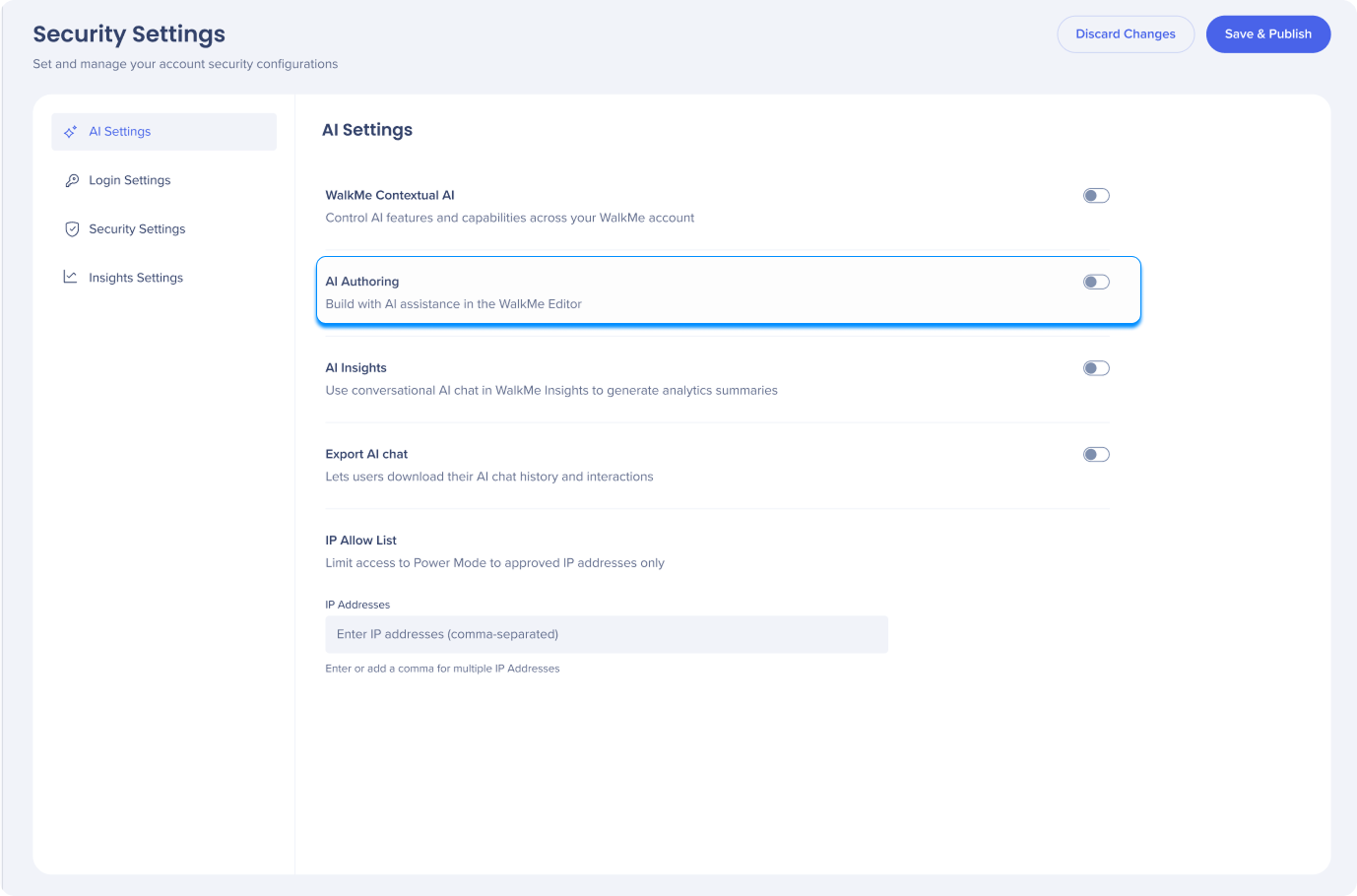
In the WalkMe Console, go to Admin
-
Select Security & Audit
-
Select Security Settings
-
Go to AI Settings
-
Enable AI Authoring
How It Works
Create content with a prompt
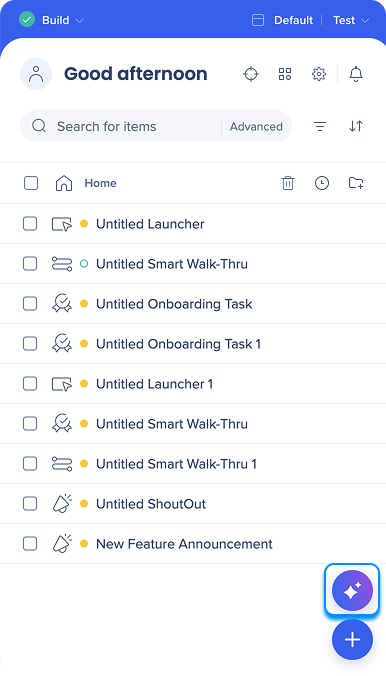
- Select the purple Author with AI icon in the bottom right corner of the editor
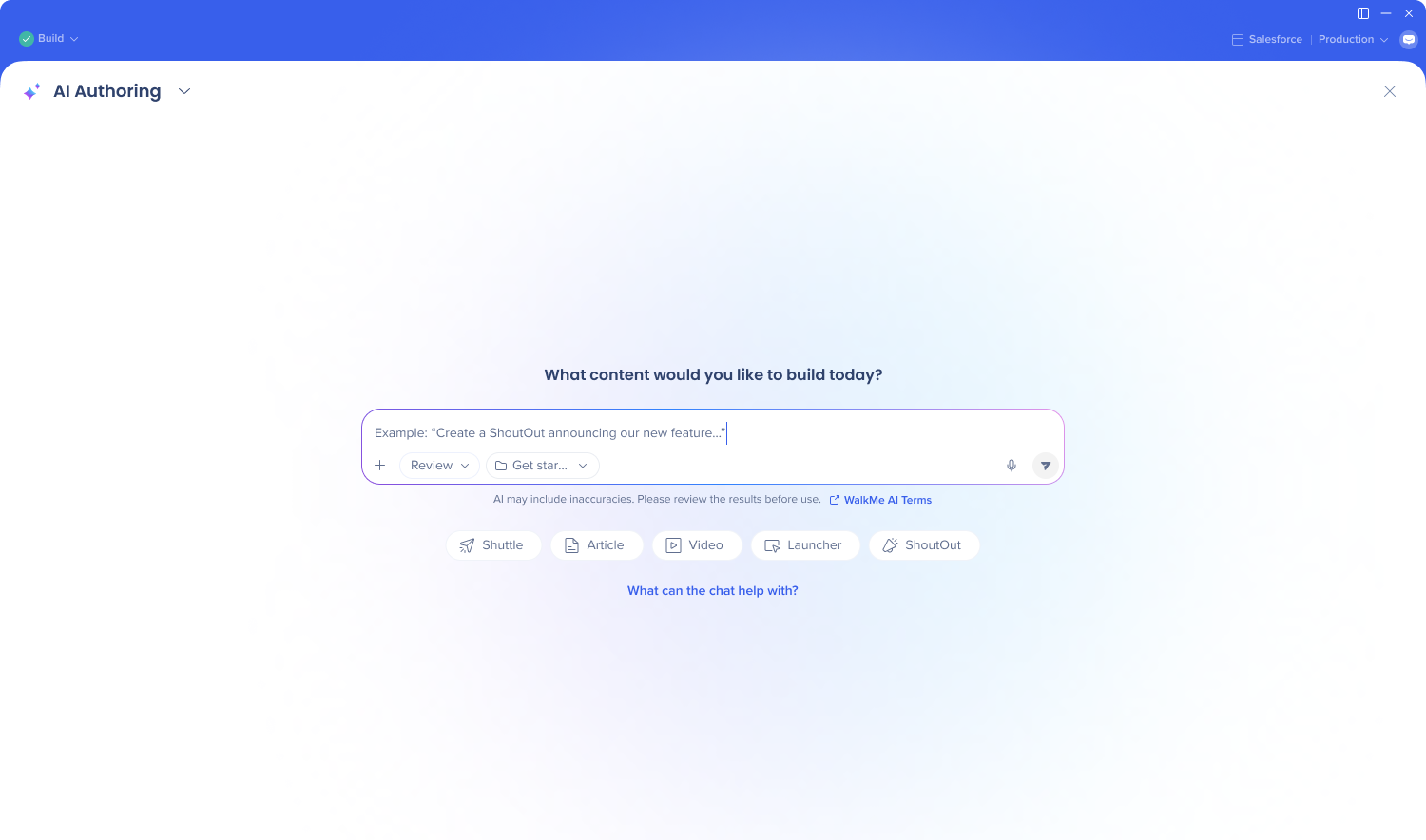
- In the free-text field, describe your goal (for example, an announcement, a navigation shortcut, or a styling change)
- To start faster, select a quick-start shortcut beneath the field: shuttle, article, video, launcher, or ShoutOut
- Select Send
- Answer the AI's follow-up questions
- It asks for what it needs before it acts — for a shuttle, that's the destination URL where you want to send users
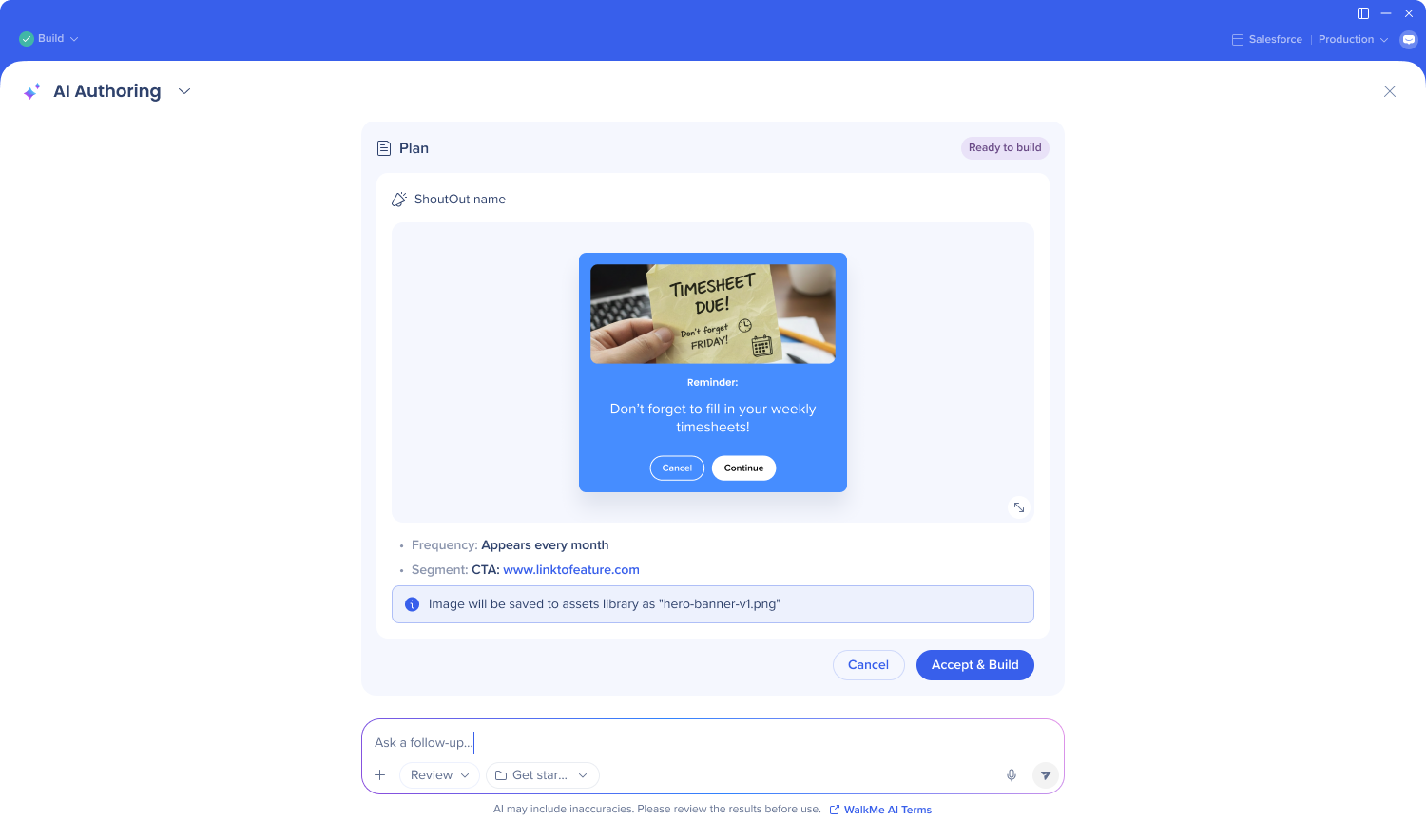
- Review the suggested plan — The AI summarizes what it will build
- Select Accept & Build
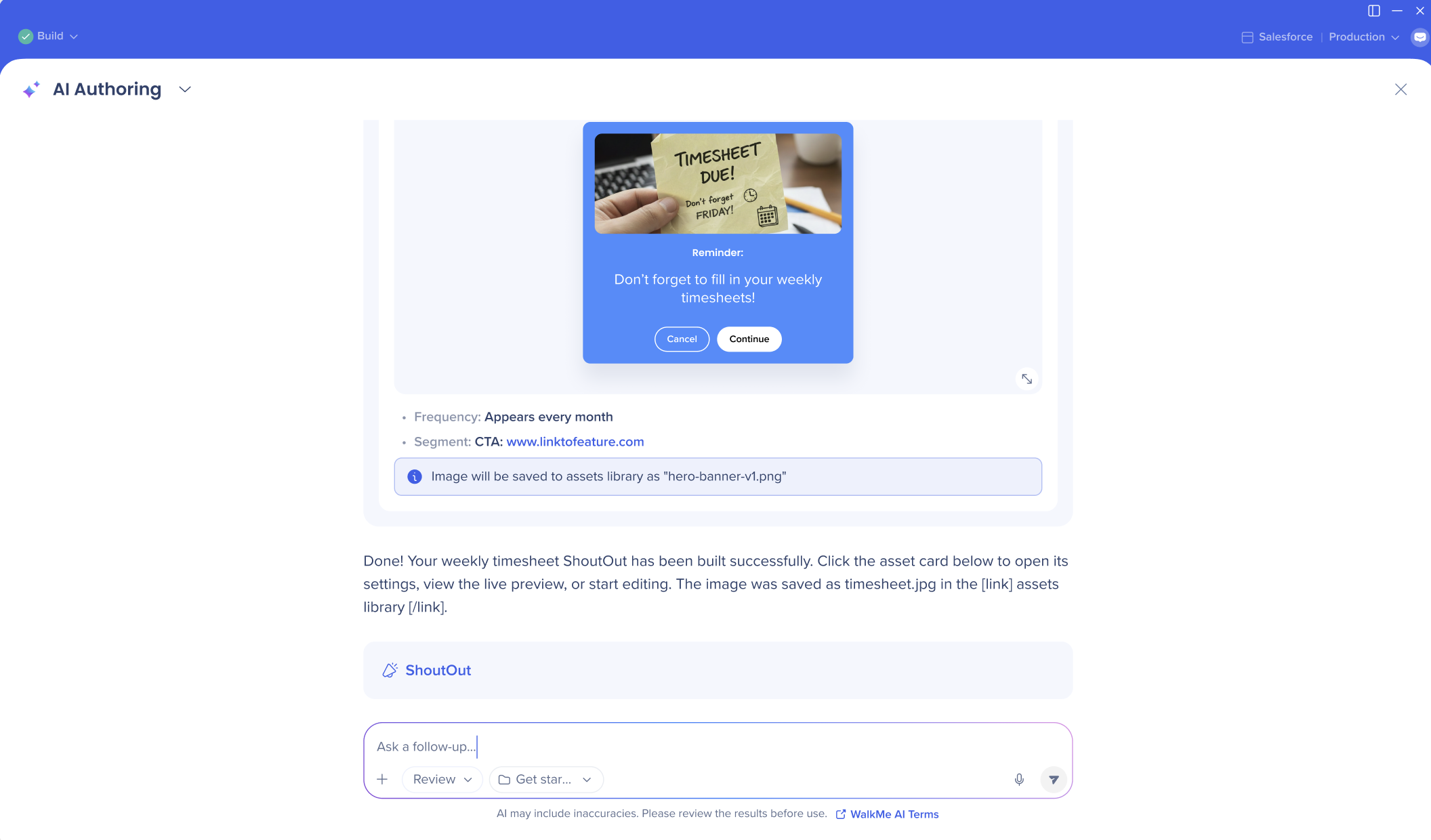
- Choose your next step:
- Refine it here — continue the conversation with a follow-up prompt
- Move to the editor — review and adjust the result
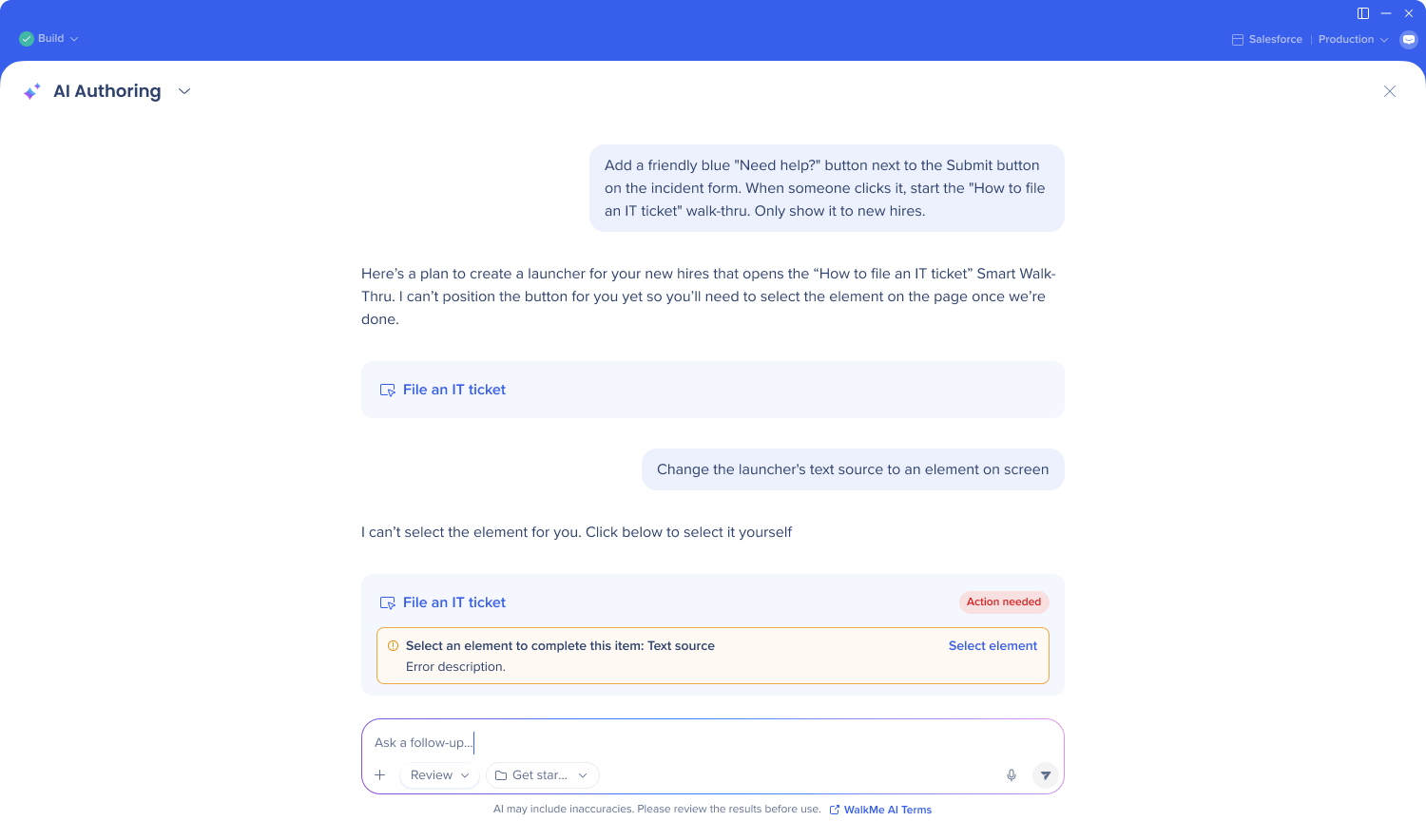
Launcher element selection
When creating a launcher, you'll have to manually select an element after AI creates the draft.
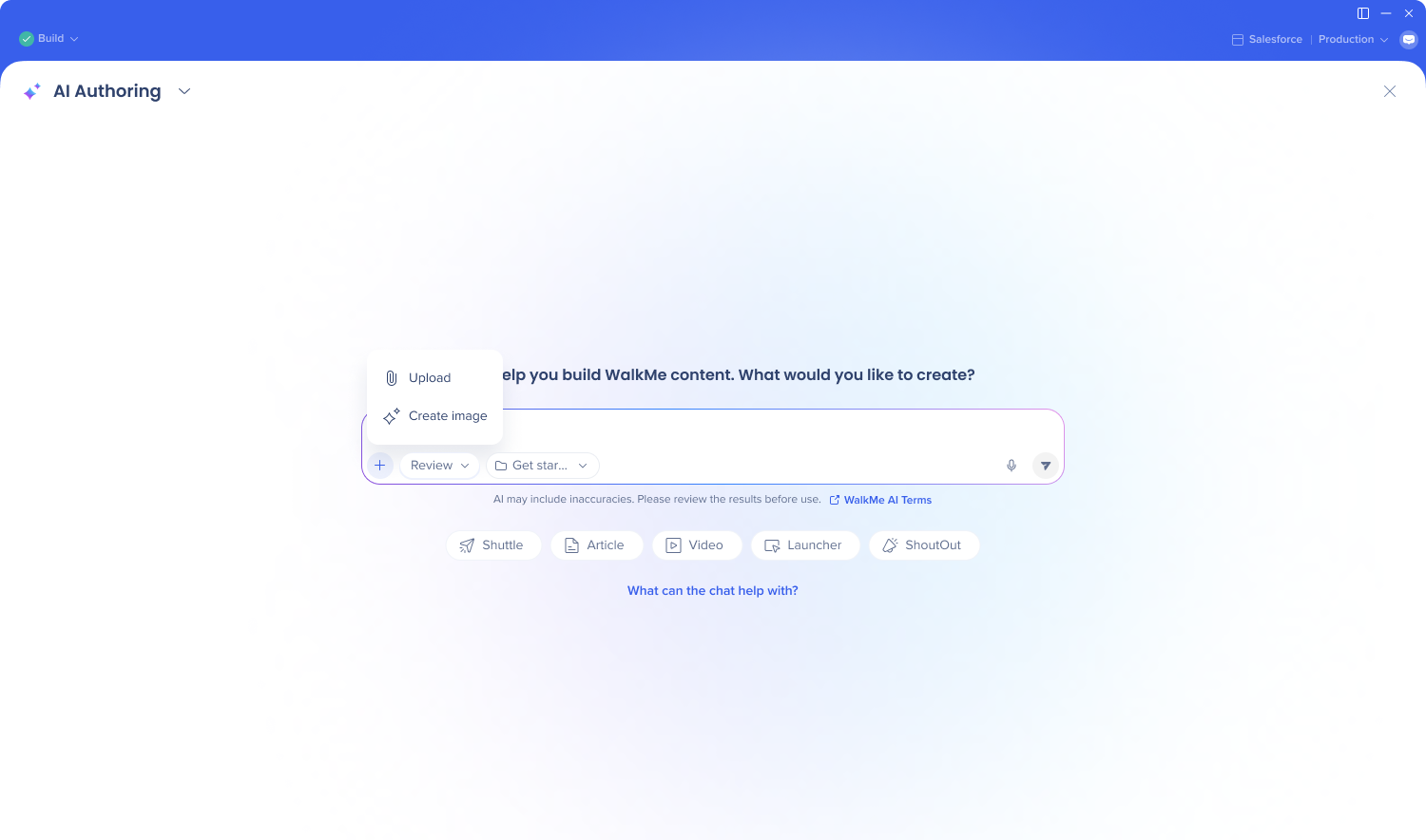
Images and attachments
Select the + Add button to upload an attachment or create and image, or drag and drop the files into the input field
- AI can generate images based on your request in plain language
- These images are automatically saved to the assets library
- You can also upload attachments, for example:
- A text source for AI to analyze, edit, summarize etc.
- An image to add to your ShoutOut or launcher templates
- An image to use as a reference for your content (nor recommended to use for this purpose yet, will be improved)
Supported formats and sizes
- Images: PNG, JPG, JPEG, GIF (≤ 20 MB each)
- Documents: CSV, TXT (≤ 30 MB each)
Building mode
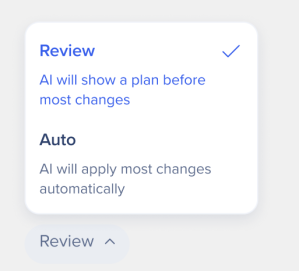
The building mode toggle controls how the AI applies changes to your content:
- In Review mode, the AI shows you a plan before making larger changes, giving you the chance to confirm before anything is built
- In Auto mode, the AI applies changes directly without pausing
- In both modes, minor changes may be applied automatically
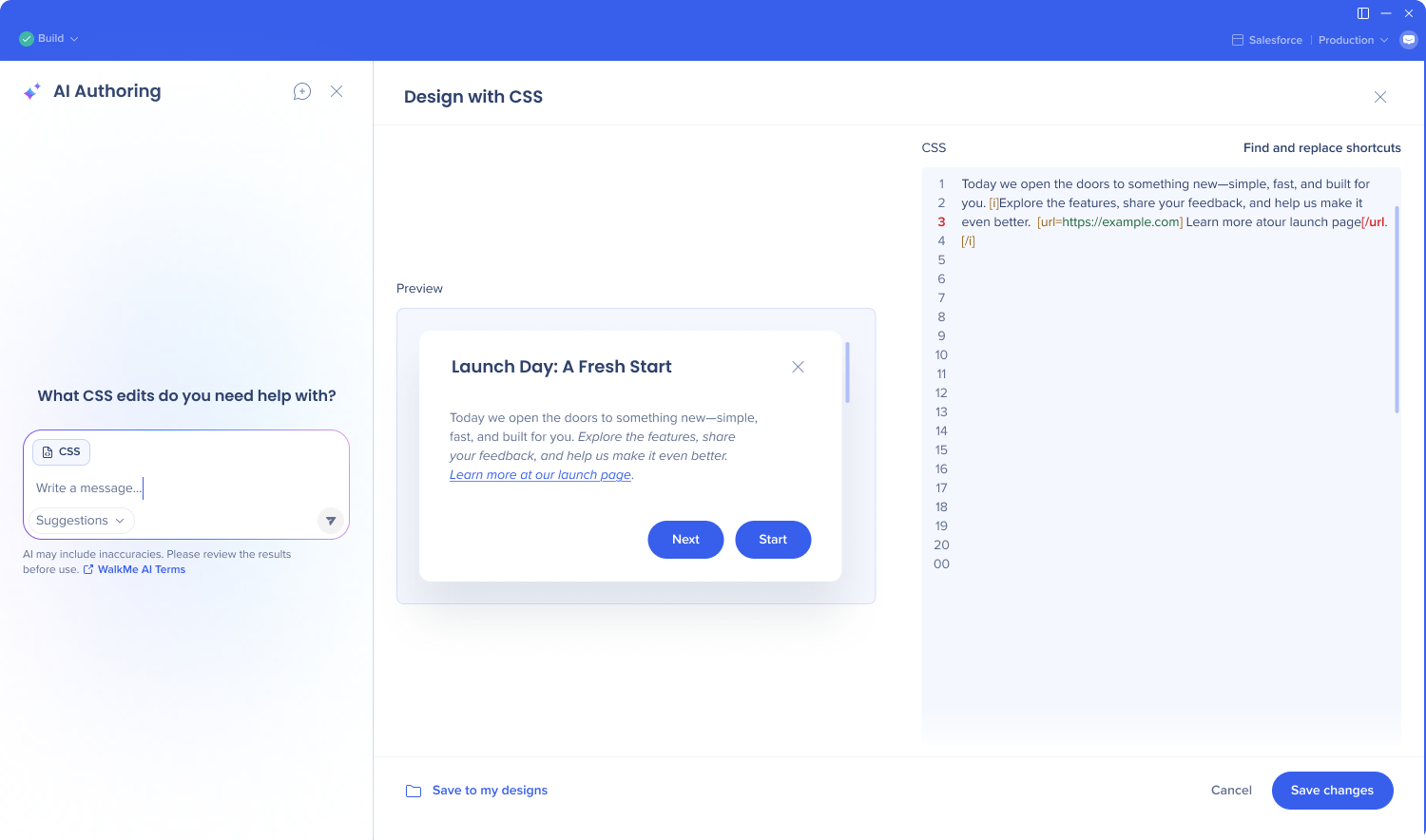
CSS
Beyond creating items, you can use natural language to write or adjust CSS. Describe the styling you want, and the AI translates it into the underlying configuration.
Conditions
You can also use AI to create conditions — describe the logic, and the AI translates it into the underlying configuration.
Note
Dynamic text attributes, number/date comparison rule, and on screen element condition aren't supported.
Advanced settings
AI Authoring supports the Advanced Settings tab for launchers and SmartTips. You can ask the AI to change how WalkMe identifies an element — for example, to update the jQuery selector — instead of editing it manually.
Example prompts
- "Change the jQuery selector of the 'Submit request' launcher to #submit-btn"
- "Use the jQuery selector input[name='email'] for the Email SmartTip"
Select element
The AI still doesn't select elements for you. Select the element in the editor first, then ask the AI to adjust its advanced settings.
SmartTips
Describe the SmartTips you need in plain language, and the AI builds a draft SmartTips set with one SmartTip per field. One prompt can cover several SmartTips.
- The plan and confirmation cards always show the set, with its SmartTips listed underneath
- New sets are marked New set, and existing sets are marked Existing set
- Each SmartTip is marked as Guidance, Validation, or Guidance + Validation
Element selection
The AI creates each SmartTip without an element. Select the element for each SmartTip in the editor, then save the Set. Your selections are kept only once the Set is saved.
AI Authoring: SmartTips
Restore previous versions
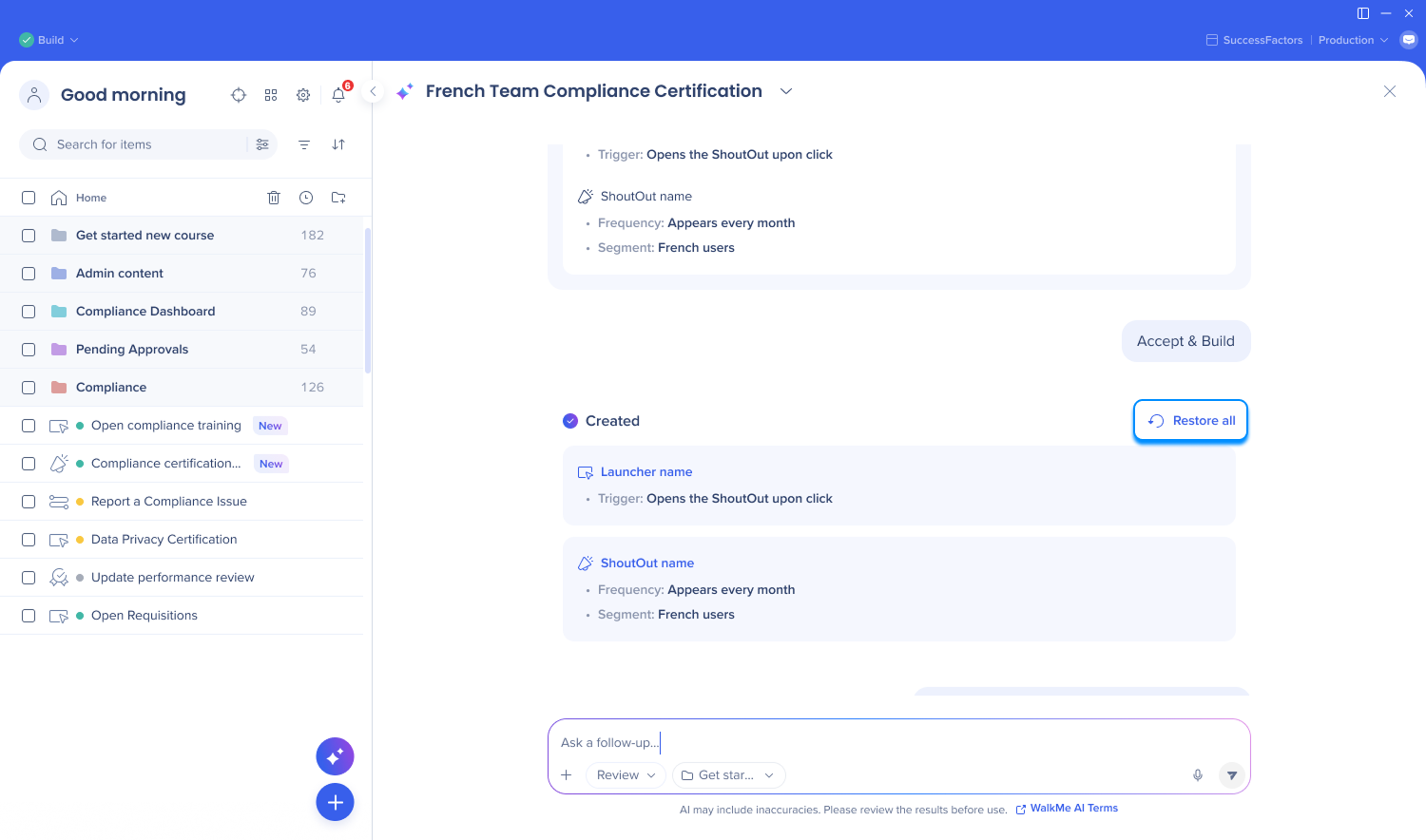
Changes the AI makes are saved in your version history, so you can undo them right from the chat:
- Restore all: next to the prompt, restores every item that prompt created or changed
- Restore: on an item's card, restores only that item
There's no need to choose a version. Each item goes straight back to its previous version once you confirm.
- If some items are already restored, Restore all restores the remaining items
- If an item was deleted, it's skipped, and the remaining items are restored
- If a prompt changed only one item, you'll see Restore all instead of a restore option on the card
- Restore all doesn't appear on the most recent message in the chat
Templates
- Restoring a single launcher or SmartTip points it back to its previous template. The template itself isn't restored, so other items that use it keep the current design.
- If the prompt edited a template, Restore all restores the template too, and every launcher that uses it goes back to the previous design. Before it restores, the AI lists the other items that will be affected and asks you to confirm.
Version History
What you can ask AI
Create and edit content
-
"Create a ShoutOut for employees announcing the new travel policy. Generate a sleek, colorful 3D illustration of a business traveler at an airport with travel documents. Add a 'Review the policy' button that opens a new Shuttle to www.[newpolicy-example].com. Show it once a day, to a new APAC segment where var location = APAC"
-
"Create a ShoutOut called 'Month End Notice' with the headline 'Month end summary' that shows on the last day of every month"
- "Create an onboarding task that plays a video called 'Your first day at WalkMe' fromwww.youtube[example].com, and completes once the video has played"
-
"Create a launcher called 'Browser Rules' that appears when the URL contains 'salesforce', and only in Chrome or Firefox"
-
"Create an Action Bar launcher that summarizes the highlighted text"
-
"Add the prefix [v1] to all my content in draft mode"
-
"Update the z-index of all my launchers to 10"
-
"Move all ShoutOuts into a new folder called 'Old ShoutOuts'"
-
"Change the button color of {ItemName} to bright green"
-
"Create an article resource named 'Manager Guide' pointing to www.article[example].com, with the description 'Quarterly manager process' and the search keywords manager, quarterly, process"
-
"Generate an illustration of a rocket launching and save it to the asset library as 'Rocket'"
- "Move all ShoutOuts from Home to the 'Q4 campaigns' folder"
- "Assign the 'Help' launcher to the 'New hires' segment"
- "Remove the 'Month End Notice' ShoutOut from the 'APAC' segment"
Find out what's built
- "List everything in this account, grouped by content type"
Ask how to
- Ask the chat anything about WalkMe content and how to create it
- AI will pull answers from our Help Center using the AI Answers integration
Technical Notes
Not supported in this version
- Smart Walk-Thrus and SmartTips
- Publishing or archiving content
- On-screen element in text sources and conditions
- Dynamic attributes
- Selecting elements for you
- Element identification (Advanced settings tab)
- Configuring global settings
- Classic ShoutOuts and surveys (not planned)
-
Custom LLM
Systems
Design limitations
- The AI builds only with the design options the editor UI supports today — it can't add capabilities the UI doesn't have.
Template elements
- Templates support images, icons, and buttons. These are the elements available in templates; legacy elements aren't supported.
Template theming
- Unless you specify otherwise, the AI creates templates within your existing theme, so new content matches your established styling automatically. You can also prompt it directly — for example, "connect my templates to the theming default variables" — to link a template to your theme's default variables.
- If your prompt asks for styling outside your theme, the AI creates it as requested and disconnects that item from Theming. For example, if your theme colors are blue and you request a purple launcher, the AI builds the purple launcher and disconnects it from the theme. Only that item is affected.
Data collection
- AI Authoring doesn't collect any new data on its own. The only account-specific input it uses is what a builder types into a prompt — for example, item names, URLs, or descriptions.
Data storage
- Conversation history in AI Authoring is kept for 18 months. This history isn't used to train the AI model.
Models
- Currently, WalkMe uses Gemini for content and image generation, and Perplexity for internet search, within AI Authoring. However, WalkMe reserves the right to change the LLM vendor in the future to enhance the performance and quality of the service.