Brief Overview
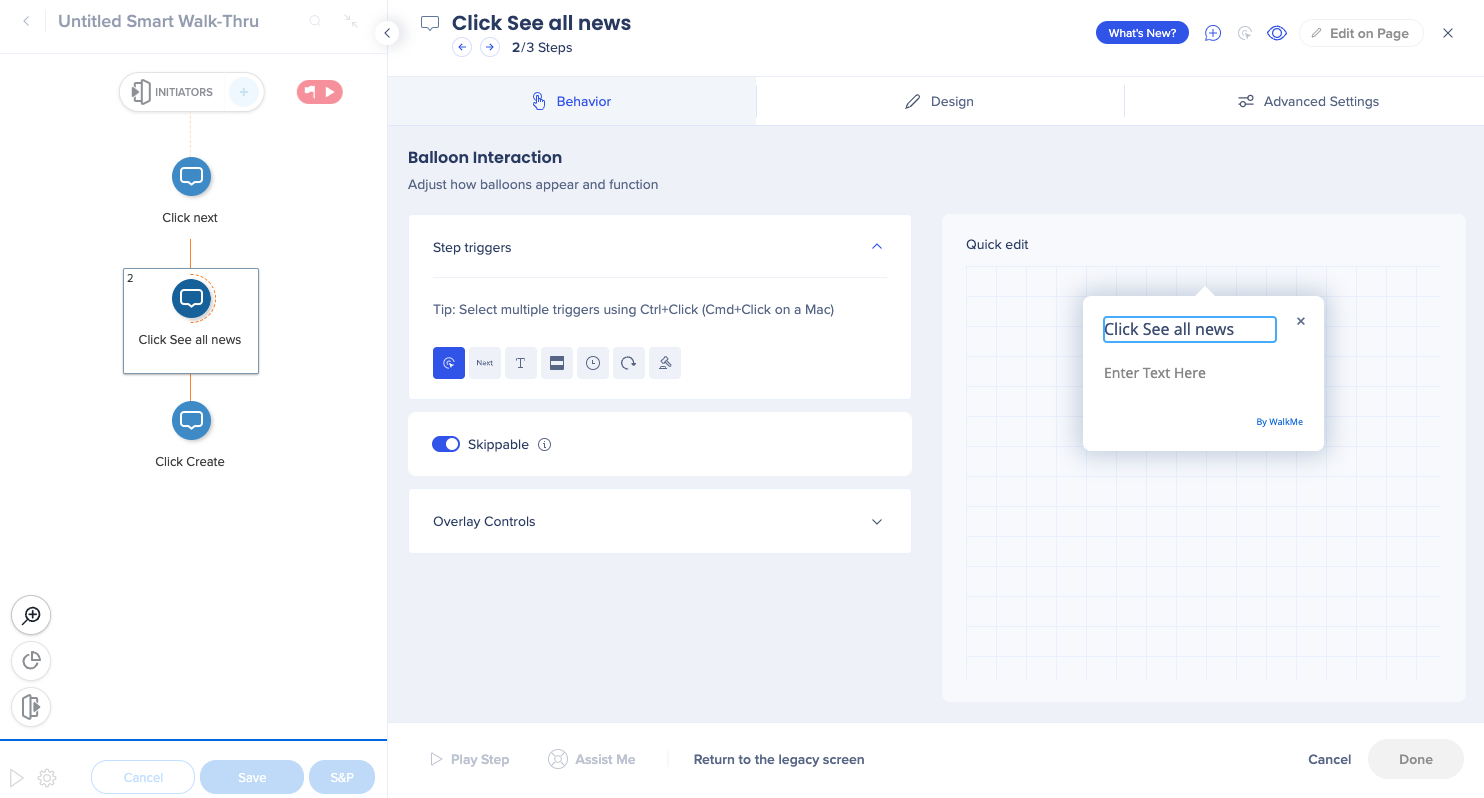
Skippable steps let Smart Walk-Thrus continue when a step's target element is not found. By marking a step as skippable, you ensure that the flow progresses smoothly even when elements appear conditionally or vary by user role.
This article explains how skippable steps work, when to use them, how to configure them, and how they behave in complex flows.
Use Case
Consider a form that behaves differently based on country selection:
- Selecting United States displays an additional State field
- Selecting a European country does not display this field
By marking the step that targets the State field as skippable, the Smart Walk-Thru continues regardless of which country is selected.
How It Works
In process-oriented solutions, not all elements are always present on the page. This can happen when:
- Different user roles see different fields or actions
- Form fields appear or disappear based on user selections
- Pages load dynamic content conditionally
When a Smart Walk-Thru reaches a step whose element cannot be found:
- If the step is marked as skippable, the Smart Walk-Thru skips the step and continues
- If the step is not skippable, the Smart Walk-Thru stops
Create a Skippable Step
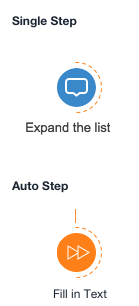
You can apply the Skippable setting to element-oriented steps, including:
To mark a step as skippable:
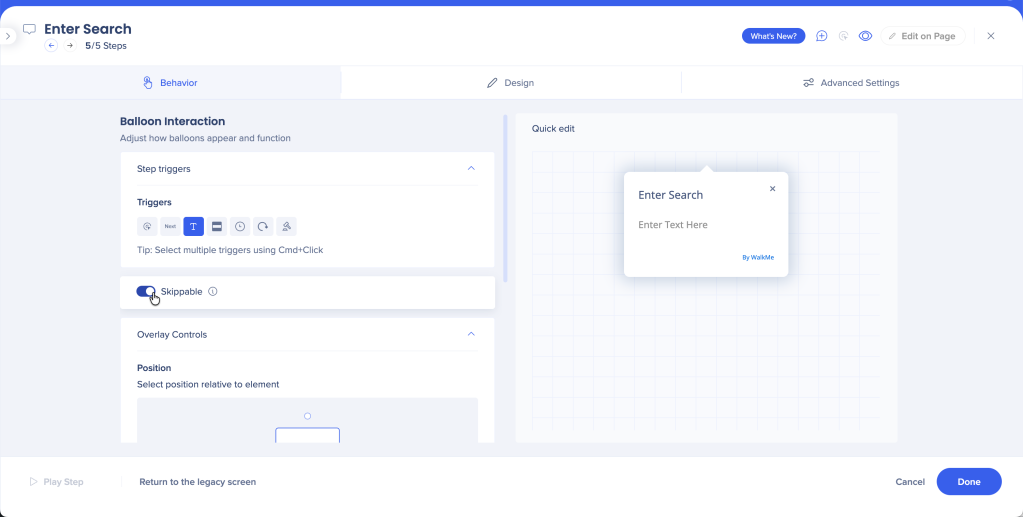
- Select the step in the flow map
- Open the Behavior tab
- Turn on the Skippable toggle
In the flow map, skippable steps are indicated by a dotted semi-circle icon.
Skippable Peer Step Behavior
Peer steps can cause users to get stuck if no triggers are available to advance the flow.
When the main step in a group is skippable and its element is not found:
- If none of the peer steps include triggers, all peer steps are skipped
- If any peer step includes a trigger, the Smart Walk-Thru plays the peer steps
Triggers can be added to peer steps using BBCode.
Using BBCode at WalkMe
Flow Tracker
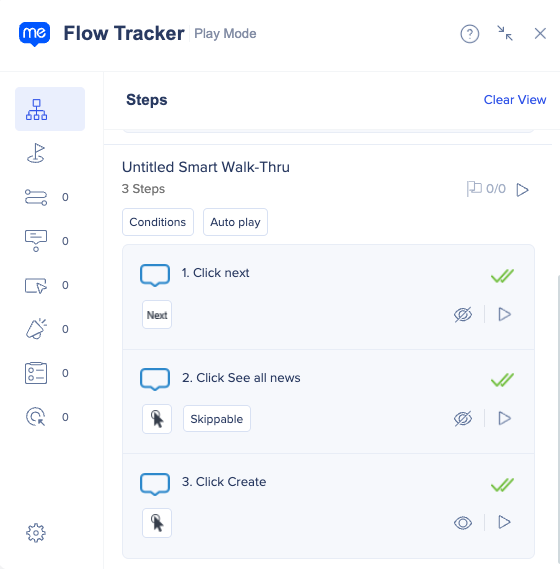
Flow Tracker displays an indication when steps are skipped during a Smart Walk-Thru. This lets you verify that skippable behavior occurred as expected during playback.
Best Practices
- Use skippable steps only when element visibility is truly conditional
- Avoid marking critical instructional steps as skippable
- Test flows with different user roles and input combinations
- Review Flow Tracker data to confirm skipped steps align with expectations
Tip Tuesday Video: Skippable Steps in Action
Technical Notes
- Skippable steps apply only to element-oriented steps (steps and auto steps)
- Skipped steps do not block flow progression


